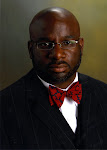
Monday, October 26, 2009

Blood is thicker than water...

For me, the day was best summed up by one of our members who approached me after service saying how upset she was that she only had one Kleenex for the day. It was truly a tear jerker for many of the 400 to 500 worshipers on yesterday at Historic St. George's United Methodist Church as Mother Bethel African Methodist Episcopal Church returned home for worship. Although there have been gatherings of the 2 congregations over the past 200 plus years, this is the first time that both churches have worshiped together at the 11am hour. This is an important point to remember, for the walk out of Richard Allen and Absalom Jones was not an event between 2 denominations, but it was a tearing apart of one congregation. And I must say, it felt good be back.

The service was highlighted by serving Holy Communion with a chalice presented to St. George's in 1785 by Methodist founder, John Wesley. Adding to the significance was Wesley Chapel in London, England (John Wesley's church) singing the same hymns as our service at their morning worship as a sign of solidarity. Keeping in the spirit of pan-Methodism, we were joined in worship by the spouse of Bishop Jeffery N. Leath, Dr. Susan Leath, Episcopal Supervisor of the 19th Episcopal District (South Africa); a caravan of worshipers from Bethel African Methodist Episcopal Church in Baltimore, MD, (which stands side-by-side with Mother Bethel in it's important historical role in the founding of the AMEC); Metropolitan African Methodist Episcopal Church, the National Cathedral of African Methodism, in Washington, DC; and Hemmingway African Methodist Episcopal Church in Maryland; along with a host of other UMCs and AMEs from the local and regional area.

The day was capped off for me when I received a hand made cross from Rev. Fred Day (pastor of St. George's) that was crafted from nails used to build the balcony in which Richard Allen was pulled up from his knees in prayer. Nails, which once symbolized segregation and division, had now been turned into a symbol of God's redemptive power. The nails remind us that in spite of all that divides us, we are united by the blood. It is the blood of Jesus, shed for our sins, which unites us and brings us to a place where we recognize that blood is thicker than water!

In an effort to share the many different faces and voices from the day, here are links to news stories done by CBS, ABC, the Philadelphia Inquirer, KYW News, and photos taken by a reporter with the UMC News. Enjoy!

http://cbs3.com/video/?id=90085@kyw.dayport.com

http://abclocal.go.com/wpvi/video?id=7082155

http://www.kyw1060.com/topic/play_window.php?audioType=Episode&audioId=4111418

http://www.umc.org/site/apps/nlnet/content3.aspx?c=lwL4KnN1LtH&b=5259669&ct=7612683&tr=y&auid=5516658

http://www.philly.com/inquirer/home_region/20091026_Methodist_congregation__split_by_racism_200_years_ago__unites.html

http://www.philly.com/inquirer/opinion/20091101_Editorial__Segregated_Sundays.html

http://picasaweb.google.com/EPAConference/StGeorgeSAndMotherBethelWorship#

http://picasaweb.google.com/lhs1967/StGeorgeSUnitedMethodist?authkey=Gv1sRgCJWLyeGqgP-B0gE&feat=email#

http://picasaweb.google.com/lhs1967/MotherBethelAMEChurch2009?authkey=Gv1sRgCMDxh42p1fjK0wE&feat=email#

Wednesday, January 21, 2009

Change we can believe in? A few thoughts from W.E.B. DuBois

Much has been written and said about the recent inauguration of our 44th president, Barak Obama. At the swearing in ceremony, my camera caught the image of the Black National flag in the foreground with the American flags in the background. For some reason, this picture has been on my mind since Tuesday. I think I finally understand why it has been with me. It is related to the words spoken by W.E.B. DuBois over 100 years ago in his classic work, The Souls of Black Folk:

"One ever feels his two-ness,--an American, a Negro; two souls, two thoughts, two unreconciled strivings; two warring ideals in one dark body, whose dogged strength alone keeps it from being torn asunder.

The history of the American Negro is the history of this strife,--this longing to attain self-conscious manhood, to merge his double self into a better and truer self. In this merging he wishes neither of the older selves to be lost. He would not Africanize America; for America has too much to teach the world and Africa. He would not bleach his Negro soul in a flood of white Americanism, for he knows that Negro blood has a message for the world. He simply wishes to make it possible for a man to be both a Negro and an American, without being cursed and spit upon by his fellows, without having the doors of Opportunity closed roughly in his face."

President Obama's sudden rise to power provides an excellent opportunity for us to reexamine the words of DuBois and once again ask the age old question: What does it mean to be Black and American? Can these "unreconciled strivings" ever be reconciled? Can these 2 "warring ideals" be held in check without tearing one asunder? Can you have one service with 2 preachers, Rick Warren and Joseph Lowry, both offering prayers and not lose your mind in the process?

What does the "age of Obama" mean for the question of DuBois? Has the rule about race in America changed, or is he only another in a long list of exceptions to the rule? Only time will tell. But for now, we pray for the day when we no longer have anything to reconcile. We pray for a day when our Blackness is not viewed as being at war with our American-ness. We pray for a day when others will value (and not despise) the unique gifts and perspective that comes from being Black in America. Let's hope that this will also be a part of the change we can believe in.

Tuesday, December 2, 2008

My 1st Sunday at Mother Bethel: A day to remember


A few weeks ago, on my first day preaching as the new pastor of Mother Bethel, the congregation was hosting the Richard Allen Foundation (RAF) in celebration of Liberation Sunday. The day is set aside each 3rd Sunday in November by the RAF to commemorate the exodus of black worshipers at St. Georges Methodist Episcopal Church on a cold 3rd Sunday in November in the late 1700s. This movement gave rise to 2 new congregations, the African Episcopal Church of St. Thomas led by Absalom Jones and Mother Bethel led by Richard Allen.

The dream of Third District Supervisor Ernestine Henning (pictured along with St. Thomas' Rector Martini Shaw and myself), the RAF's aim is to keep alive the spirit of Bishop Allen and the founders of the African Methodist Episcopal Church. While in worship at Mother Bethel, a candle was lit and taken to the tomb of Richard Allen in the basement of the church.

The theme for the day selected by the RAF, you ask? From Richard Allen and Absalom Jones to Barack Obama. My sermon title for that morning, you ask? From the Slave House to the White House. Isn't God deep!

Following worship at Mother Bethel that morning, an afternoon service was held at St. Thomas (click here for the full story in the 11/25/08 copy of the Christian Recorder, #17) on the other side of town. In that inspirational service, we were led back in time through lectures, song, and dramatic interpretation.

It was during that moment that the weight of this new appointment really hit me. Here I was sitting next to the pastor of St. Thomas, the direct pastoral descendant of Absalom Jones on my very first Sunday in the direct pastoral line with Richard Allen on the anniversary of their historic declaration of independence. Talk about putting the appointment into the proper historical perspective!

Not only were the members of Mother Bethel extremely gracious and welcoming to our family on that day, but we also had an opportunity to share with the members of St. Thomas. It was truly a day to remember and a day for remembering!

Monday, November 24, 2008

Press Release: New Pastor of Mother Bethel stands on broad shoulders of predecessors & brings passion for history


Okay, I know that there is probably a much more creative way to make this announcement, but frankly, I'm still speechless. I'll just say "Thank you, Lord!" and thanks to Bishop Norris for the trust he has placed in me to represent all of you at the Mother Church. With that, I’ll let the press release say the rest.


PRESS RELEASE

Rev. Dr. Mark Kelly Tyler, Ph.d. IS NAMED THE 52ND PASTOR OF historic MOTHER BETHEL AME CHURCH IN PHILADELPHIA
, Pennsylvania, the oldest property continuously owned by black Americans. Dr. Tyler is a dynamic preacher and pastor having led congregations in California, Missouri, Ohio, and New Jersey. Dr. Tyler is also a skilled teacher serving as an adjunct professor at Payne Theological Seminary in Ohio and New Brunswick Theological Seminary in New Jersey.
Dr. Tyler has become widely known in the AME Church for his love of AME Church history. His passion and knowledge are not only demonstrated in his sermons and teachings, but also during his recent campaign for the office of Historiographer in the AME Church. During the year-long campaign, Dr. Tyler developed a grassroots following using such efforts as his blog: Tyler’s AME History Notes (www.markkellytyler.blogspot.com).
While Dr. Tyler’s aspiration to serve as Historiographer was not realized at the General Conference, the loss turned into a gain by paving the way for him to serve as the 52nd pastor of Mother Bethel. He is excited about this new chapter in his ministry that fuses his passion for history with his love of serving as a pastor in the AME Church. “It is a tremendous honor to serve as the pastor of Mother Bethel,” Tyler said of his appointment. “This congregation has stood as a beacon of hope for citizens of Philadelphia for more than 200 years. But far beyond the borders of the City of Brotherly Love and Sisterly Affection, Mother Bethel is also a symbol of liberation, hope and self-help for members of the AME Church throughout the world,” Tyler added.
Dr. Tyler succeeds Bishop N. Jeffrey N. Leath, who served at the head of Mother Bethel for the past 15 years. Bishop Leath was elected and consecrated the 128th Bishop of the AME Church in July 2008. Elected at the head of his class, Bishop Leath now serves as the presiding prelate of the 19th Episcopal District of the AME Church in South Africa.
Consequently, the pastor that Bishop Leath succeeded in 1993 is Bishop Richard F. Norris the 116th Bishop elected and consecrated in 2000 and current leader of the 1st Episcopal District. Dr. Tyler received his new assignment from the hand of Bishop Norris 2 weeks ago.
Dr. Tyler is a native of Oakland, CA. He is a graduate of Clark Atlanta University with a B.A. in Religion, Payne Theological Seminar y with the M.Div., and the University of Dayton with an earned Ph.D. in Educational Leadership.
Mother Bethel’s building and Museum are located on the corner of 6th and Lombard Streets. It is open for guided tours Tuesdays through Saturday, from 10am-3pm, and Sundays after the 8am and 10:45am worship services.

Monday, November 10, 2008

8 Days in November: How the AME Church Represented Black America at the 1876 Centennial Celebration


(On the left: Bust of Bishop Richard Allen; Above: Bishop Richard Franklin Norris, along with Dr. Susanna Gold and ph.d. candidate Rob Armstrong, stands on the site where the Bishop Allen bust was dedicated in 1876.)

In 1876, the United States of America threw a 6 month party to celebrate 100 years of nationhood. The Centennial, held at Fairmount Park in Philadelphia, opened on May 10 and closed on November 10. Intended to display before the world America's great diversity, black Americans were conspicuously absent and silent.

When Frederick Douglass, for example, showed up for the opening ceremony in May to take his place on the main stage, he was not allowed to address the enormous crowd. In fact, he almost was not allowed on the stage. Although he possessed valid credentials, Philly's "finest" refused to let him pass. It took the intervention of a U.S. senator from New York to get America's most famous black man to his seat. So rather than wait for someone to offer a seat at the table, the AME Church took its' own seat.

Determined to have a black presence at the Centennial, members of the Arkansas Annual Conference devised a plan to erect a monument in honor of AME founder, Bishop Richard Allen. Under the leadership of Revs. John T. Jenifer and Andrew J. Chambers, $7,000 was raised to commission a stunning, 22' high, imported Italian marble sculpture that would hold a bust of Bishop Allen. Every map of the Centennial that has survived includes the Bishop Allen Monument, making it the the only exhibit set up by, about, and expressly on behalf of black Americans.

The monument as intended, however, was not to be. Continually met by delays, setbacks, and ultimately disaster, it seemed as though it was destined never to make it to the exposition. Scheduled for unveiling in Philadelphia on the 4th of July, the sculptor did not deliver on his promise. The committee was forced to push the full dedication back to September, but soon met a new challenge. As the monument was shipped from Cincinnati, the train that transported it encountered some type of accident crossing the Susquehanna River in Pennsylvania. The entire 22 foot high, elaborate monument, with the exception of the bust of Bishop Allen, was destroyed in the accident.

Feeling somewhat defeated, the committee purchased a plain 9' granite pedestal shaped like a pyramid and placed the bust of Bishop Allen on top of it. To add insult to injury, the guest speaker for the dedication on November 2, never arrived. Remarks were given by Bishop John M. Brown and the Richard Allen Monument was dedicated. Being on display for only 8 days in the 6 month long Centennial, it must have seemed that all the effort was simply in vain.

But that would miss the larger point. Remember, there was a concentrated effort to stifle the voice of dissent and the voice of the oppressed. But the monument offered an opportunity for the AME Church to say on behalf of others, that which could not be said on the main stage.

J.T. Jenifer at the first dedication of the monument's base in June, delivered a sermon that the organizers of the Centennial surely did not want the world to hear. According to Jenifer, the "outrages and murders committed upon us are the fruits of wanton prejudice, hatred, and hellish passion, suffered to satiate itself under the weakness of the Government upon the plea of State rights." Unlike most speech by black Americans of his day, the words were not relegated to the pages of the black press. This speech was reprinted in its entirety in the pages of the widely read Philadelphia Press for all the world to see.

In closing his address, however, Jenifer did not look back to the pain of the past or on the struggles of the present. Rather, he looked forward with hope to future generations imagining the world 100 years later:

"We are here today before the eyes of all nations to show our appreciation of the American Centennial. We shall not be here the next national anniversary, but our children will be. They will not come as we have come, but they will come greater--come with their productions. They will come in their arts, their science, their literature, and in their philosophy, in all of which they shall excel. Color lines will then be wiped out, caste will be gone; the American citizen, white or black, will be honored and loved, and mind and moral excellence will be the measure of the man."

But the period of hope that Jenifer spoke of in his speech would have to wait, at least for a little while.

Following the end of the expo, the monument committee asked the Fairmount Park Commission to allow the bust to remain in the park as a lasting tribute (like the Catholics and others were allowed to do), but they were denied. Within a few weeks, the monument was taken down and placed at Wilberforce University.

The symbolism of Bishop Allen being "put out" of the park was fitting for the times, for a few months later the period of Reconstruction had come to an end. The clock was rolled back on blacks in America, Jim Crow laws became the rule of the land, civil rights were revoked, voting rights were denied, blacks were run out of elected office, and the greatest period of terror on free black men began as lynchings became common and widespread.

The dream of Jenifer may have been delayed, but it was not to be denied. 100 plus years later, we are the evidence that all things are possible with God. We sit today as the fruit of his dream. There are still giants to face and mountains to climb, but in the words of the black church, "we may not be where we want to be, but thank God, we're not where we used to be!"

Saturday, November 8, 2008

The Slave House to the White House: From Hercules to Obama and the meaning of the black presence in the Executive Mansion


When the nation's first president, George Washington, occupied the Executive Mansion in Philadelphia (at that time, Washington, D.C. had not yet become the nation's capitol), he did a very odd thing for the leader of a newly freed democracy that proclaimed that all men were created equal: he imported slaves from his Virginia plantation to serve him in what would become known as the White House. In the White House, across the street from the United States Congress, on 6th and Market Streets in Philly, President Washington set up slave quarters in the residence that was meant to be a beacon of freedom for all the nations to see.

When talk about slave quarters in the White House first began a few years back, the National Park Service argued that slaves never lived in the mansion. They did not want to mar the image of the executive residence by suggesting that something as ugly as slavery lived there, so they denied it. But on last year, as excavation began on for a new memorial to be built on the site where the house previously sat over 200 years ago, a funny thing was exposed below the ground: slave quarters. A slave house in the White House, just think about that for a moment.

The irony obviously did not escape his enslaved servants, either. Hercules (believed to be the man in the above portrait on the left), one of the slaves that was brought from Virginia, served as the Executive Chef in the White House kitchen. By all accounts, he lived an enviable life, even for a slave. He was allowed to sell leftovers from the kitchen to local residents and made an estimated profit of $200 a year. However, no matter how comfortable his life was or high he rose, he was still a slave.

It is very likely that Hercules came into contact on a regular basis with the free black population of Philadelphia, including AME Church founder, Bishop Richard Allen. In addition to being a pastor, Allen was also a master chimney sweep and one of his contracts was with President Washington. It is difficult to believe that Hercules and Allen (himself a former slave) would not have had contact while in Philadelphia. Seeing free black men and women come and go as they pleased must have taken a toll on Hercules. When he could no longer take being a slave, he packed what he could carry, slipped out into the night, and disappeared never to be seen of again by the president. Hercules ran as fast as he could away from the White House.

Yes, in the 1790s, blacks were running away from the White House. But now, 200 plus years later, blacks are now running to the White House! When President Elect Obama and his family walk through the doors of the White House, they will represent more than just the First Family. They will represent more than just a change from one political party to the next. They will represent, as Maya Angelou most eloquently expressed it, "the dream and the hope of the slave." They represent the dream of Hercules, the dream of Olney Judge (another escaped White House slave), the dream of the millions of slaves and those who died in the Middle Passage before even making it to the Americas. They are a powerful reminder that sometimes, dreams do come true.

Speaking of dreams, isn't it interesting that 40 years after the death of Dr. Martin Luther King, Jr., the Moses of the Civil Rights Movement, we have come to the place where God has raised a Joshua to take the movement in a new direction. Could this be what Dr. King saw from the mountaintop that night before his death in his last speech? If that sounds like a stretch, consider this fact: we stand exactly 40 years after Robert F. Kennedy proclaimed on "Meet the Press" that he believed a black man could be president in 40 years. Imagine it, 40 years is the same period of time that the Hebrews had to wander in the wilderness before God allowed them to enter into the Promised Land, and now black Americans have lived long enough to witness that which was hardly a dream just one generation ago.

But that is glory of what only God can do. God can move you from the "slave house" in life and place you in the "White House" even though all the odds are against you. Someone said it this way, "He picked me up, turned me around, and placed my feet on solid ground." For what we have witnessed on this past week, to God be the glory!

Wednesday, October 29, 2008

A Day in November to Remember: Revisting the Camden Election Riots of 1870


On Tuesday morning, November 8, 1870, the Philadelphia Press newspaper ran the following blurb about the day's coming election: The election polls in the various precincts and townships of Camden county [sic] this morning open at seven o'clock and close at seven this evening. By the next morning, the same paper ran the following headline on the front page: Election Outrage in Camden! The "election outrage" would ultimately lead to the conviction of a white police officer, the severe wounding of numerous innocent black men, and the death of Theophilus Little, a black man who died of wounds received at the polling place while trying to exercise his right to vote.

This event was nothing less than an act of domestic terrorism on the black residents of Camden, yet, it is amazing that this story is not widely known by many people in the area. Thanks to the coverage from the Christian Recorder, the Philadelphia Press, the New York Times, and the ultra conservative Camden Democrat (the Fox News Channel of the day), it was not too difficult reconstructing the events of that day. In Philadelphia, a statue is being planned in honor of Octavius Catto, a local school teacher killed in the Philadelphia election riots in 1871. However, the seeds for that riot were planted one year earlier right across the river in Camden. In fact, it is highly likely that some of the same thugs (many of whom happened to be off duty Philadelphia police officers) were involved in both the 1870 and the 1871 riots.

Before heading to the polls on that fateful Tuesday morning, black citizens of Camden had already received word of voter suppression and intimidation waiting for them if they dared to exercise their newly guaranteed right under the 15th Amendment. For that reason, many of the men gathered early in the morning to vote as a group before a mob had a chance to gather. They formed 2 lines determined that no one would break them and they marched down to what is now Centerville in Camden to cast their ballots. What they did not know at the time, was that this was no ordinary mob waiting for them.

The mob, in this case, was led by the very persons who had sworn to serve and protect the citizenry, regardless of race and class. The leader was Constable Thomas Souder, backed up by Justice of the Peace James Henry and Attorney Samuel Davis. Attorney Davis' job was to challenge black voters to determine if they were "qualified" to vote (Wow, sounds vaguely familiar). This group of "peace officers" was backed up by a notorious group from across the Delaware River known as "Fox's Police." Mayor Fox of Philadelphia was no friend to black voters. In fact, as the riots occurred in Camden, black men who arrived in Philadelphia from New Jersey on the ferries that same day were immediately met by uniformed Philadelphia police officers and arrested for suspicion of voter fraud.

As the election went on back in Centerville, the "peace officers" recognized that the vote was not going their way. The new black vote, representing some 300 persons, would represent a major shift in local politics if it continued. Seeing that they could find no legal reason to stop them from voting, the Constable and Justice of the Peace led the off duty Philadelphia officers and others right into the lines of black men. They began beating them with blackjacks, clubs, and pistols. Charles Williams was shot as he tried to get off the floor and Theophilus Little was hit so hard, he would die within days. The black men were driven out of the polling place where they reformed their lines.

What happened next was not exactly a scene from the Civil Rights Movement or an episode of "Eyes on the Prize", as attested to by the Philadelphia Press:

"The colored men, rallying in their turn, drove their assailants from the polling place.[Justice of the Peace] Henry was badly injured; his nose was broken and he was severely cut about the head. Henry Thomas, who was engaged with [Constable] Souder and Henry in the attack upon the blacks, was also severely beaten. From this time until late in the afternoon everything was quiet."

Having no one there to protect their rights, this group of black men stormed the polling place against an armed mob of peace officers and took their right to vote!

I wish that I could report that this was the end of the violence that day, but it wasn't. The mob simply waited for a more opportune moment. Late in the afternoon, the mob stormed into the polling place, stole the ballot box, took it outside and began to smash it to pieces! This time, Sheriff Morgan and the mayor of Camden stood up for the rights of their black citizens and called on the National Guard troop to restore order. Led by Colonel J.M. Scovel, order was restored, blacks were able to complete the voting process, and the white peace officers were arrested and held over for trial.

What is truly remarkable about this story is that the U.S. District Court did not merely slap the hands of the peace officers in this incident. Bail was set on each person arrested and not one defendant was released until their role was thoroughly examined by the federal authorities. The efforts of the U.S. District Attorney in the case led to the indictment of 23 persons and Constable Souders was the first to go to trial. The trial lasted only 2 weeks in 1871 and a guilty verdict was returned. While I have not been able to determine at the writing of this post the results in the remaining indictments, it is clear that this was a moment celebrated by the victims of the rioting on that fateful day in November.

This is a timely reminder for those of us who might complain about standing on a long line on November 4, 2008. Yes, you may have to give up some time and convenience to cast your vote because of the expected high voter turnout, but isn't that a small price to pay when we consider what others have done on our behalf? When those men shed their blood in 1870, it wasn't just for them. They shed it for those of us today who they would never, ever know. They shed it so that we would not have to shed ours. We owe it to them to show up to the polls and cast our vote. The blood of the martyrs cries out that we show up and cast our vote every time the polls open. Whether or not there is a black man on the ticket as president is irrelevant, voting for black Americans should been viewed as a sacred obligation. After all, isn't it the very least that we can do?

Wednesday, October 22, 2008

Underground Railroad History made in South Jersey AME Church


Above is a trap door used to hide escaping slaves. To the right is the pastor of Jacob's Chapel, the Rev. Terrell Person, my colleague on the Camden-Trenton District.

[This article is reprinted here from the Courier Post Newspaper, October 22, 2008, by Lavinia DeCastro, www.courierpostonline.com]

MOUNT LAUREL Members of Jacob's Chapel African Methodist Episcopal Church in Mount Laurel celebrated their congregation's 195th birthday by remembering the past and preparing for the future.

During a ceremony last week, Jacob's Chapel launched the "Join The Journey Capital" campaign to raise $1 million over the next three years to preserve the church's two historic buildings (Jacob's Chapel and the Colemantown Meeting House) and Civil War cemetery. The money will also be used to buy land to erect a new building to house a growing membership.

"We want to bring these buildings back to the way it was in the past with the pot-bellied stove and stained glass window," Pastor Terrell W. Person said.

Housing one of the oldest African-American congregations in the state, the church was established in 1813. It was part of the Underground Railroad, which allowed escaped Southern slaves to reach the North.

A key player in the development of the Underground Railroad was Medford-born William Still, son of slaves Charity and Levin Still, who escaped long before the formal railroad route was devised.

Most of the Still family is buried at the church's cemetery, including Dr. James Still, the famous "Black Doctor of the Pines" and herbalist.

The congregation first met in the Colemantown Meeting House, believed to be among the oldest original black church buildings in the nation. Inside, hand-hewn beams outline the frame of the Quaker-built structure, which is still used for Sunday school.

In 1850, the congregation built a new church on land donated by a local Quaker, Albert Jacob. Jacob's Chapel is named after him.

"We have an opportunity to preserve this history right now and we must," said Department of Environmental Protection Deputy Commissioner John S. Watson Jr., the keynote speaker at the event. "Our duty as public servants is to preserve these places and to help people understand why they're important."

Watson vowed to help the church list its structures on the state and national Register of Historic Places and secure state funds for preservation.

"We stand with you in spirit and resources," Watson told the more than 100 people who attended Saturday's event.

In addition to restoring the congregation's historic structures and archives, Person said he wants to purchase five more acres of land to build a 300- to 400-seat sanctuary and community development center.

"The past is important, but we also have a community to take care of," said Person, a descendant of Dr. James Still.

The church already owns four acres across the street from the Elbo Lane chapel.

"The people who have gone before us, the Harriet Tubmans, the William Stills, the Quakers, they have laid down such a foundation for us," said Charles Buffington II, the lead consultant for the capital campaign. "We share their treasure, but it takes money for restoration, it takes money for development, it takes money to build a house of faith."

Helen Gaines, of Moorestown, has a great-uncle, Civil War veteran George Robinson, buried at the cemetery.

"I've been here ever since I was born," Gaines said. "I'm looking forward to restoring this church."

Reach Lavinia DeCastro at (856) 486-2652 or ldecastro@courierpostonline.com

[To contact the Jacob's Chapel to assist in their Capital Campaign, call 856-235-7900.]


Tuesday, August 26, 2008

Michelle Obama, Family Values, and my late grandmother Iowa Milan

Last night was truly historical.

Even the most anti-Obama, anti-Democratic party, pro-McCain pundits had to acknowledge that Michelle Obama hit a home run with her prime time moment in Denver. Her speech provided an open window for those outside the black community, through which they were able to see that our values are not so different than those held by everyone else in America.

Many white Americans, unfamiliar with what it means to be black and American, hold the false assumption that the vast majority of blacks expect reward without work, success without sacrifice, and a paycheck without putting in 40 hours.

I'm not sure how much Mrs. Obama's speech did to make a dent in that myth, but it was certainly a big step in the right direction. Just in case you missed it, here's what she said about the family values imparted to her and her brother from their parents: "that you work hard for what you want in life; that your word is your bond and you do what you say you're going to do; that you treat people with dignity and respect, even if you don't know them, and even if you don't agree with them."

Listening to Mrs. Obama, I felt like she was telling the story of my family. I'm sure that many black Americans felt the same way. I want to dedicate this posting to the memory of Iowa Milan, my late grandmother. Much of what we value as a family, we learned from her. She was born and raised on a small farm in Cominto, Arkansas (about 12 miles from Monticello). Yet, as an only child, her 5 children have now produced a large and thriving family, most of whom still live in the Oakland, California area. Her story is not just a story about our family, but it is an American story.

Like the parents of Michelle and Barak Obama, she gave all of her life so that our lives would be better. She didn't just give to her 5 children, but she kept on giving to her grandchildren and great grandchildren as well. In fact, her death in 1988 of cancer was the direct result of her sacrifice for her family. There is little doubt that her disease found its origin in her work in World War II as a black "Rosie the Riveter."

Shortly after the United States entered WWII, she heard that there were jobs in California for black women who wanted to work. She left her small children with family in the south, boarded a train for a state she'd never visited, and took with her only the faith in God that somehow things would work out. When she arrived, she went to work at the Moore's Dry Dock, where she helped convert ships into wartime vessels that served in the Pacific Ocean.

She went to work there every day, even though she was called out of her name by white co-workers who also had come from the south and brought with them their own brand of explicit racism. She was told that women, especially black women, did not belong there working alongside white men. She and the other black women in the yard also often felt the sting of sexism from black men, who like their southern colleagues did not appreciate their presence. Yet, in spite of the duel demons of sexism and racism, she went to work every day to make a better place for her family.

The first thing she did when she got on her feet, was to send for her children. Unlike my own upbringing in which I lived in the same home that my parents owned since I was 2 years old, my mother and her siblings lived in the housing projects in West Oakland. Side by side with other southern transplants, they brought with them the values of hard work, honesty, and love for your neighbor. They looked out for one another, they shared what little means they had, and they helped raise the children of the community together.

This story is not unique to our family. Blacks from New York and New Jersey can tell the same story about family who came from North and South Carolina. Blacks in Detroit, Chicago, and Cleveland can tell the same story about family that came up from Mississippi, Alabama, and Georgia. In many ways, this is a mirror to the stories of European and Asian immigrants to this country. It is the story of grandparents who came with nothing but a prayer and a dogged determination to make it, but left a legacy for their descendants.

Her sacrifice, however, came with a great price. Working in the shipyard during the war exposed her lungs to asbestos. By the time she discovered the cancer, there was little to be done. But she used the occasion to teach us one last lesson. She did not express outrage at the shipyard or at God for the disease, but she showed us that faith is not just for the good times. Without mumbling or crying about how unfair it was, she quietly submitted to God's will and went "back home."

That was really her greatest legacy that she left our family: her unwavering faith in God.


I remember back in 1987, when I left Oakland to attend Clark College in Atlanta, she imparted in me that legacy. She didn't have a trust fund to give me money for tuition, but what she gave me has lasted to this very day. As we all gathered at the San Francisco Airport to wait for my flight, she called the family into a large circle just before I boarded. There, in the midst of all of those other travelers, she led us in prayer.

Because I was the first to go away to college, I thought no one in the prayer circle could understand what was going through my mind. I was headed out to a place I had never been before. We could only afford one ticket, so I had to fly alone. While other students were accompanied by fathers and mothers, I was all by myself. We didn't even have family in Atlanta to meet me. I was being picked up by a stranger who rented me a room.

But what I did not realize until all these years later thanks to reflecting on Michelle Obama's speech, is that she knew more than I could have imagined about how I felt. She'd been there and done that. When she prayed for me, she called on the name of the same God who she called when she boarded that train for California some 40 plus years before all by herself. She prayed to the same God who took from a suitcase to a job with a pension at the Post Office; from the projects to home of her own; from her children scattered to her children living with her under the same roof. So when she prayed for me and my journey not knowing what tomorrow held, she prayed knowing full well Who held tomorrow.

And for her, well, that was enough.

(Just a few of Iowa's descendants at worship at Brookins AMEC, Oakland, where she was a founding member, choir member, and Trustee. 8/17/2008)


Thursday, July 31, 2008

Historic Moment caught on camera: Bishops and AME Leaders Pray with Obama

Each time that I've attended the General Conference, there has been a moment when I've realized like Moses that I was standing on "holy ground." That moment occurred this year when the presumptive nominee for president of the Democratic Party, Barak Obama, addressed the Conference. The afternoon was truly electric! It must've been the way it felt to see Dr. Martin Luther King, Jr. speak at the March on Washington.

Like many others, my eyes began to fill up with tears, so overcome by the emotion of the day. My mother and my aunt, both born in Arkansas were there that day in the packed out St. Louis Convention Center. All I could think about was how they were barred from the movie theater growing up (and confined to the balcony on days they could attend) in their hometown. How they were forced to attend segregated schools and use public accommodations for "blacks only." Yet, there they were looking at something no one could have dared to believe just 40 years ago.

I'm indebted to my cousin, the Rev. Reginald Terry, pastor of Antioch Baptist Church in Omaha, Nebraska. Knowing my love of AME history, he forwarded this photo by email after he received it from someone else. It is so rich, I simply could not keep it to myself. It is meant for sharing. I do not intend to suggest that prayer be taken lightly or that Mr. Obama's devotional life should be intruded upon like the person who took his prayer out of the Wailing Wall in Jerusalem. I hope that readers know that this posting comes from a different place.

It comes from a deep and profound sense of appreciation of just how far God has brought us. This picture of Bishops and leadership of the AMEC, the spiritual descendants of Richard Allen, Sarah Allen, Morris Brown, Jarena Lee, William Paul Quinn, Daniel A. Payne, and Henry M. Turner, praying over a black man who is only a few days away of potentially doing the "impossible," is bigger than just the few hands that could reach him that day.

When the Bishops stretched out their hands to pray, they prayed with Obama on our behalf. We couldn't all fit in that little room behind the stage to pray with him, but our Bishops prayed for us. They prayed on behalf of AMEs not just in the United States, but in Canada, Jamaica, the Dominican Republic, Liberia, South Africa, Tanzania, England, and parts all over the globe. They prayed for the ordained and the laity. They prayed for those with fancy titles behind their names and they prayed for Aunt Jane on the last pew.

That's why I wanted to share the picture. I wanted to share it because it belongs to all of us. May God continue to show Mr. Obama favor and may we all continue to pray with him and his family.

***The photo above was taken by Vashti-Jasmine McKenzie and is posted with her permission.***

Sunday, July 13, 2008

Revisiting the Historiographer Campaign and the General Conference of St. Louis, 2008

First of all, congratulations to Dr. Dennis C. Dickerson on his re-election to the office of Historiographer. It was a long shot (to be sure) to win the election over an incumbent, but we ran a very competitive race. More than anything, however, we had fun running last week. The campaign allowed me an opportunity to display what I truly love, the history of the African Methodist Episcopal Church.

Special thanks to Mr. Chester and Mrs. Lillie Owens of Kansas City, KS for allowing us to display the holdings of Bishop John Gregg. The display was a big hit during the week and drew many visitors from the military, Edward Waters College, Wilberforce University, and South Africa to view photos and artifacts specific to each of those interests. Also, a big thanks to Linda Kennedy, Brian Purlee, and the St. Louis Black Rep Theater for sharing their teens from the Summer Youth Program. In the words of one person, they were an "instant hit" at the Conference. They were dressed each day in 1800s clothing, sang in the hallways of the Convention Center, and performed on the stage each day (check out these links to see them on YouTube: http://www.youtube.com/watch?v=3emUYCsaXDs and http://www.youtube.com/watch?v=ng-AfUZewtA).

I would also like to thank each of the 519 delegates who cast a vote for me. Wow, 519, to God be the glory! Also, I would like to thank each person who contributed, who volunteered, and who prayed for the campaign. I'm truly thankful for my congregation, Macedonia AMEC in Camden, NJ, for the continued support they have shown. I thank my co-campaign managers, Rev. Bruce Butcher and Sis. Jackie Weary, the members of my congregation, and my family (my mother, aunt, and sister) who traveled to St. Louis to help. I certainly thank Bishop Richard Franklin Norris and Mother Norris for their support, Presiding Elder Robert C. Wade and Sis. Wade, and all the members of the First, Third, and Fifth Episcopal Districts for not forgetting their son. Lastly, I thank my wife Leslie M. Tyler and my children for supporting me in this time-consuming effort this past year.

I often look to historical events to place current situations in perspective. I must say that I am not totally surprised by the turn of events in St. Louis. I feel that God gave me a warning in advance. Just before flying out to St. Louis, I picked up my copy of The Pilgrimage of Harriet Ransom's Son (the autobiography of Bishop Reverdy C. Ransom). Incredibly, my eyes fell to the page when Ransom ran unsuccessfully for bishop in 1920. The General Conference that year, just like in 2008, was held in St. Louis. Although he did not win that year, he was successful in the following General Conference in 1924 in Louisville, KY.

There are many reasons that Bishop Ransom is one of my favorite bishops: his consistent commitment to social justice, his care for "the least of these," and his innovation, to name a few. But the most important reason that I've always felt drawn to his story is that he lived his life following the voice of God, rarely concerned with the political fall-out of his choices. Over and over, he made moves that simply made no "AME sense." Yet, he still rose to the highest position the Church had to offer and will be remembered as one of the most important AME voices in the first half of the 20th century.

Perhaps that is why he entitled his autobiography "the pilgrimage" and not "the rise" of Reverdy Ransom. A pilgrimage defined is "a journey, especially a long one, made to some sacred place as an act of religious devotion." Ransom's life was truly a long, winding, religious journey that often seemed to veer off course in the eyes of his peers. His rise in African Methodism was not a straight line, but more like a winding road. Yet, he still made it where God intended for him to go.

Maybe someone else, other than just me, can relate to that experience. I entered the race for Historiographer because that is what I felt God placing on my heart. Now that it is over, we shall see how God causes this experience to fit into the rest of the tapestry God has done in my life. I'm not sure what tomorrow holds, but I am sure that God already has some ideas. For those of you who like me, find that following God is truly an adventure and a pilgrimage, I offer the life and witness of Bishop Ransom as evidence that things still work out in spite of what may appear to be a setback. If you are in the midst of your own journey right now, take comfort in the words of that great hymn:

Guide me, O Thou great Jehovah, Pilgrim through this barren land. I am weak, but Thou art mighty; Hold me with Thy powerful hand.

Thursday, June 26, 2008

Understanding Black Liberation Theology: A 40-Year Retrospective

As we approach the 40th year of Black Liberation Theology, this is a must see event! Click on this link to see AME scholars James Cone and Obery Hendricks, along with former Riverside Church pastor James Forbes, Dwight Hopkins, and Calvin Butts, as they struggle with this issue.

We owe a debt of gratitude for their individual contributions to the Struggle and to the Schomburg Center in Harlem for making this presentation available.

Tuesday, June 17, 2008

Philadelphia Area Book Signing raises new (and troubling) questions for AMEs

Richard S. Newman, in writing one of most comprehensive works on the life of our founder, Bishop Richard Allen, has done a marvelous job in pulling together facts and chronological events; yet, he has been able to keep the story fresh and alive. Freedom's Prophet is really a page turner and difficult to put down once you pick it up.

This Thursday, June 19, 2008, from 5:30pm to 7, Newman will meet and greet the audience, read selected portions, and sign copies at the Library Company . Those attending the General Conference in St. Louis should also know that the book can be ordered from my exhibitor booth for a deeply discounted price (booth #125).

If I have any criticism about the book thus far, it is simply this:

Why is it that others outside of the AME Church seem to appreciate our history more than us?

The last major work published on one of the "Four Horsemen" of the AMEC was in 1992 by Stephen Angell when he wrote his biography on Bishop Henry McNeal Turner (Bishop Henry McNeal Turner and African-American Religion in the South). Like Newman, Angell is not AME. In fact, neither of them are of African descent (at least directly). We should be grateful that Newman and Angell have such a broad and open research agenda and have proven themselves as first rate scholars, but what about us?

When is someone going to write a major, comprehensive biography on the life of Jarena Lee (the next comprehensive biography on her life will be the first--thank the Lord that she wrote her own story down!)? What about those founding mothers and fathers in West and South Africa who helped shape African Methodism in the Motherland? Who will tell their story? What about the story of how the AME Church spread to other parts of the world?

Have we no one in our own ranks to tell our story? Have we no one qualified and trained to pick up the tools of research and answer the question of whence we've come? Must we always sit back and hope that others will find our history important enough to write and then interpret it for us? Do we always need someone else to tell us what it means to be AME?

Some will say that there is no audience or market for our material. However, when I recently tried to purchase some copies of Freedom's Prophet in bulk for the upcoming book signing, the warehouse had already sold out of the first printing (the book was just released in March!). Obviously, someone is reading it.

Fortunately, there are those in the ranks of the AME Church who have contributed greatly to the scholarly discourse on the history of the AME Church (Reginald Hildebrand, Theresa Fry Brown, Bernard Powers, to name a few). However, even they will say that there are far too few of us spending our precious time in research on questions involving the AME Church. Let us hope that Newman's new work on Bishop Allen (which ironically highlights his self-determination) will inspire future AME researchers, scholars, and writers to find a research agenda in one of the most fascinating places of them all, the African Methodist Episcopal Church.

Sunday, June 8, 2008

Tyler for Historiographer Campaign "Goes Green": Check out Digital Ad Book

I am grateful that on tonight, June 8, 2008, my Presiding Elder (Dr. Robert Christopher Wade), Rev. Stanley Justice, President of the Camden-Trenton Ministerial Alliance, pastors, and laity of the Camden-Trenton District, and my own congregation (Macedonia AMEC, Camden, NJ) have planned a major fund raiser in support of my effort to become the next Historiographer of the AME Church at the upcoming General Conference. The Rev. Dr. Stanley Hearst and the good members of Bethel AMEC in Moorestown, NJ were good enough to open their doors for the service, in which the Rev. Reginald Jackson (candidate for Bishop) is to preach. Donations have literally come in from all over the country, for which our family is deeply appreciative.

As we neared completion of the ad book, Rev. Tresa Carter (a member of my staff) laid out the book in Microsoft Powerpoint. After seeing it in its animated form in full color, we did not want to cut costs and run it in black/white. We also faced the challenge that people (especially businesses) who placed ads would only get limited exposure for the significant amount of money paid for the ad. In addition to all of this, the overhead to run off several hundred copies and mail them out (even in black/white), would defeat the purpose of a "fund raiser."

So, taking all of those issues in consideration, we have literally "gone green" with this souvenir book. Not only will all persons at the event tonight who paid for an ad receive the book in CD version, it is also available for download from my blog in the "Favorite Links" section (or by clicking here: http://download.yousendit.com/9C12D8E46A23AB1E or clicking the picture above).

This download is free and available to anyone who would like it. An very positive and unintended consequence of this effort is that businesses and other patrons will literally now have a world-wide audience thanks to email and the web. This is good for trees, for advertisers, and for the campaign! I call that a win-win-win situation. I hope that you download it, enjoy browsing through it, and share it with others. Maybe the next ad book will come with soundtrack!

Sunday, June 1, 2008

History is now a family affair as First Lady catches the history bug: "Unpacking" the mysterious Rev. S. J. Patterson

Disclaimer: I know that some of you will say I’m only doing this because my husband is a candidate for the office of Historiographer of the AME Church. Well, that is only partially true. You see, I’ve been bitten by the “history bug.” All it took was one find from my own personal past to convince me we need to build an International Archives for the AME Church NOW – so that our richness and greatness can get out of our boxes in our basements…

It was Christmas, 2007, my first time back at my parents house since my father died more than a year ago. The homecoming was bittersweet. My mom had just undergone a successful kidney transplant operation. While getting a new kidney was what we had prayed for more than four years, I dreaded being back in the house I had never been in without Daddy. So I, in all my nosiness, did what any other “daddy’s girl” who spent her lifetime as an investigative journalist would do… I started pouring through his things trying to, somehow, bring myself closer to him. “Super Snoop” is what Daddy dubbed me more than 20 years ago…

I found his baby pictures – old images that are hard to distinguish from pictures today of my 3 year old daughter, Sharon. In an instant, I reflected on him saying “She looks just like me” after seeing Sharon’s picture when she was born. And as if it were yesterday, I remember replying “No, Daddy, she looks like Mark…” Guess he was right, as always. I also found his high school diploma – a framed document that for my entire life hung prominently on the wall of every home we ever lived in. On this day, I actually took the time to read it…. Then I stumbled upon a box that was marked “Dr. WA Patterson, Jr., MD.” The box was filled with items that belonged to my late grandfather, who practiced medicine in Miami, Florida. I found hand written notes from my great-grandparents – written to my father when he was first born. I found old driver’s licenses, books and a ton of old pictures – grandpa loved to take pictures!

Then I stumbled upon something that really caught my attention… a large, manila envelope that had the words “Uncle Joe” scribbled on it in my father’s hand writing. Uncle Joe was my grandfather’s only brother. He died when I was 10 years old. All I ever really knew about Uncle Joe was that he had a very pretty wife, Edith, who died before I was born. He never had children and every time he visited us from his home in Winston Salem, NC, he always liked to be dropped off at the library. At his funeral, I learned that Uncle Joe was actually Rev. Dr. Joseph Patterson – distinguished professor at Winston Salem State University (a building on the campus bears his name today) and the pastor of the Wentz Memorial United Church of Christ in Winston Salem. He also lived off “Patterson Avenue” a street in Winston Salem named after him. As I grew older, Grandpa and Daddy would often share memories of Uncle Joe. Now that I’ve found this folder, it was an opportunity for me to learn more.

I tried making sense of all the papers I found. Among the documents: an obituary for Rev. SJ Patterson of Palatka, Florida, my grandfather and Uncle Joe’s hometown. In fact, our family still owns property in Palatka!


The obituary said Rev. SJ Patterson was the Presiding Elder of the South Florida Conference born in 1870, died in 1922. He graduated from Wilberforce University and was a trustee for Edward Waters College. The funeral had to last several hours because there was a long list of preachers on the program. As I flipped through the program I wondered – am I connected to Rev. SJ Patterson? If so, how? I asked my mother if she knew anything about Rev. SJ Patterson. She did not. I asked my father’s sister Pearl in Miami – she never heard of Rev. SJ Patterson. She looked at the picture from the obituary and said he looked a lot like my great grandfather – Dr. William A. Patterson, Sr. I called my grandfathers cousins in Daytona Beach – they had never heard of Rev. SJ Patterson. So Mark looked him up online in Richard R. Wright's Centennial Encyclopedia of the African Methodist Episcopal Church and found the following:

"Patterson, Rev. S. J., was born in Greenville, S. C., February 16, 1867 [I've found that the conflicting date of birth on the obituary is not an uncommon find in family research]. With his parents, Isaac and Rachel Patterson, he moved to Florida when six years old. Was converted May 1, 1887; licensed to preach July 8, 1889, by Dr. S. H. Coleman; joined the conference, March 6, 1894. He was made general missionary by Bishop T.D. Ward in February, 1896. His first appointment was to Cottage Hill, "Ybor City," a town with one member. He was ordained deacon by Bishop W. J. Gaines, March 9, 1897, and elder, March 5, 1899, at Orlando, by Rt. Rev. W. J. Gaines. He graduated June, 1903, from Payne Theological Seminary, Wilberforce, Ohio. He was elected delegate to the general conferences of 1908 and 1912. He was appointed presiding elder February, 1906, by Bishop B. T. Tanner and has been successively and successfully presiding elder since that time. He is well known and highly esteemed."

With this little bit of information I got so excited! I had to find out how I might be connected to Rev. S.J. Patterson. I launched an intensive search on Ancestry.com, where I found that Isaac and Rachel Patterson were in fact my great, great grandparents who relocated to Florida from South Carolina during Reconstruction! This helped to confirm that Rev. Samuel Joseph Patterson (likely who my Uncle Joe was named after) was the older brother of my great grandfather – Dr. William A. Patterson, Sr! That would make Rev. SJ Patterson my great, great uncle!

I cannot begin to tell you the sense of pride I felt when I realized my great, great uncle was a “highly esteemed” Presiding Elder in our home state of Florida! He served as a delegate to two general conferences and, like my husband, he graduated from Payne Theological Seminary in Wilberforce, Ohio. I wish my great, great uncle were alive today to see his legacy of distinguished scholars and church leaders. He would have been so proud that his great, great niece married an AME Pastor and scholar. I also wish I had known about my uncle, Rev. SJ Patterson before now. Had I not come home, missed my deceased father, and been snooping through his things – that box probably would have been thrown out. Sadly, all of this rich, storytelling history – like so much of ours – sits in boxes, in our basements waiting for an International Archives to call home…

Written by Mrs. Leslie Patterson Tyler, "Guest Blogger"


Tuesday, May 13, 2008

Denzel Washington and Daniel Payne: Fighting the Good Fight, Living the Dream, and Saving Black Colleges


In the late 1800s, America's first college president of African descent, Bishop Daniel Alexander Payne, of the African Methodist Episcopal Church (AMEC), had a dream. Payne led the purchase of Wilberforce University (WU) on behalf of the AMEC from the white Methodists in 1863. Imagine the bold and audacious faith that it took for a black religious body to buy a university in 1863 When the deal was made, most blacks were still living in slavery in the south (the Emancipation Proclamation notwithstanding) and those that were free in the north had more important things to do with their money than to donate to a college. Yet, Payne dreamed of a day when blacks would be in a financial position to fund our own educational endeavors:

The unity and concentration of a poor people can build up schools of learning and perpetuate them for a thousand generations--yes to the very end of time.
Upon this principle the
A.M.E. Church could build and endow a first-class college every five years. She boasts of numbering four hundred thousand. Let one-half of that number be discounted as old age and youth, unable to give anything, there would remain two hundred thousand who are able to give one dollar apiece for five successive years. Then we would be in possession of a million of dollars—a sum sufficient to build and to endow a strong and powerful college, commanding the respect and the confidence of the whole country. In like manner, a half century would put in the hands of the A.M.E. Church, ten strong and powerful Institutions, commanding the respect of the civilized world as well as the confidence and moral support of the Christian Church. She could then bide her time till millionaires could raise up themselves from her Alumni, who would take pleasure in developing her colleges into Universities. ("Thoughts about the past, present, and the future of the African Methodist Episcopal Church". The AME Church Review, Vol. 1, No. 1, p.8)

Well, a part of Payne's dream has come to pass. America now has black millionaires all over the place. Blacks have excelled in every discipline there is: arts, sports, business, education, religion, science, media, politics, and any other thing you can name. The calvary has arrived and we are now in position to lift our schools so that they may be on par with our white brothers and sisters by endowing our institutions through major gifts by a new crop of donors.

The problem is, however, that Payne's dream has been confronted by the modern, American nightmare: a self centered, materialistic, egocentric, self serving and ever growing black elite that has forgotten the bridge that brought us over. Simply put, we are the generation like those in the Biblical book of Judges, that "did what was evil in the sight of the LORD, forgetting the LORD their God" who brought them out.

An example of this forgetting and the selfish neglect on the part of those whom God has blessed the most with material means can be found by going back just 5 years to the Morris Brown College (MBC) crises and the National Basketball Association (NBA) all star game. Two seemingly unrelated events, but their relationship and timing paint a vivid picture about the priorities of those who have inherited a rich legacy. Both of these events, ironically, took place less than a mile apart from each other in Atlanta in the winter of 2003 (if you've ever been to Atlanta, the Hawks' arena looks down over MBC like the big house did over the slave quarters). MBC, like just about every other Historically Black College and University (HBCU), has struggled for years to keep the doors open. In fact, it is a miracle that so many HBCUs still exist, when most have received such little financial support. (I'm sure that black folk have given more to Nike than to HBCUs)

And so the irony did not escape me that as the NBA held their All Star Game in 2003 up the hill from MBC, AMEC officials and college administrators were feverishly trying to stop the bleeding. The AMEC raised a good deal of money in a short period of time, but it was not enough. That's when it occurred to me that if all of those who attended the all star game would have just "passed the plate," the shortfall would have been raised, an endowment would have been created, and the accreditation might have been saved.

In attendance that weekend was just about everybody that was somebody in the black community that had access to wealth. Yet, although the Atlanta newspapers that weekend were filled with the plight of MBC, no one that weekend (NO NOT ONE) stopped to ask: How can we help? How can we, who have been given so much, give something back? Maybe instead of $1000 bottles of champaign, should we can get the cheap stuff and send the balance of the money to MBC? What a scene it must have been, as celebrities threw lavish parties, spent thousands on wardrobes to impress others, and rode in $300,000 automobiles, with no thought of helping keep up the bridge that made their current lifestyles possible in the first place.

Make no mistake, before "ballers" could ball at Nebraska, UCLA, Georgia, and Duke, they were forced to ball at MBC, Clark, Morehouse, and Edward Waters. Before entertainers could hone their craft in Ivy League drama departments, Spelman was just fine. Before attorneys could learn to argue in the courtroom at Columbia and Univ. of Pennsylvania, they did so at Wiley and Tuskegee. That is the bridge that allowed us to cross over from the wilderness of slavery and Jim Crow into the promised land that now flows with milk and honey for some. How dare we forget where we came from and that we are only here because they were there for us.

That brings me to Denzel Washington. Thankfully, not everyone has forgotten where they've come from. Two weeks ago, Oprah Winfrey's Harpo Productions' studio released on DVD a must see movie entitled "The Great Debaters." The movie, which stars Denzel, is based on a 1930s debate team from HBCU, Wiley College in Texas. This movie is a something that all black people should have in their movie library and would make an excellent Father's Day gift (hint, hint).

The art of debate proved to be a pathway for many young college students to gain the confidence needed to make it in the world after college. However, through the years, the debate team at Wiley ceased to exist. But thanks to a 1 million dollar gift by Denzel and his family, the debate team is coming back to Wiley. Denzel is not alone. Oprah, Bill Cosby, Tom Joyner, and others have also shared the wealth and given back to places that they don't even call home.

Yet, those good examples have been too few and far between to make a real, lasting difference. If we are to stem the tide of black on black violence, if we are to get our boys off the streets selling drugs, robbing banks, and committing murder, if we are going to give our girls a reason to wait to become mothers because they have real hope beyond the age of 15, if we are to become as a people producers and not consumers, then we need MBC as best as she can be. We need the doors of every black college not only open, but so heavily endowed that our future generations will not have to worry about tuition because scholarships will be available for all who enter in. We, black America, need for everyone to give something back. But we desperately need those millionaires whom Payne dreamed of to help us by leading the way to excellence in giving.

To whom much is given, much is required.

Wednesday, April 30, 2008

History is against Obama’s bridge between black & white: The root of the “gap” & the slavery problem in the Methodist Church

This week, the “Jeremiah Wright” episode finally came to a head. Rev. Wright “went off” at the Press Club and Obama did what his white supporters have wanted all along, he clearly disassociated himself from his former pastor. My feelings about Dr. Wright are posted below in older postings and they remain the same, Monday’s episode notwithstanding. The concern for today has more to do with the comments made by Sen. Obama on Tuesday when he reiterated his desire to serve as a “bridge” between the different races. While Obama’s goal is truly a noble vision, the facts of history suggest that closing the gap is easier said than done.

In defining this gap between black and white people, David W. Wills says that “it is the story of a persisting and seemingly intractable gap or distance. Recurrent and sometimes heroic efforts have been made to overcome this gap, but in the end it seems always to endure” (African American Religion: Interpretive Essays in History and Culture, Fulop and Rabetou, eds.). Wills argues in his essay that since the days of the Great Awakening, through the period of Reconstruction, and up to the Civil Rights Movement, there have been periods of time when this gap was narrowed, but never closed.

Although Wills wrote over 10 years ago, the closing words of his essay are troubling and prophetic: “Since the late 1960s, there has been a clear retreat from a direct facing of the gap between black and white… Acknowledged or not, however, the gap between the races—a gap involving both the interpretation of the American experience and the degree of empowerment within it—remains one of the foundational realities of our national religious life. And however much members of both races might sometimes wish it were otherwise, the painful encounter of black and white is likely to remain in the future what it has been in the past—one of the crucial, central themes in the religious history of the United States.”

As members of the African Methodist Episcopal Church [AMEC], we need look no further than the Methodist Episcopal Church [MEC] (our mother denomination), for evidence of this fact. Prior to our founding in 1787, the MEC had opened its doors wide to black members. In fact, Bishop Francis Asbury in 1785 invited a former slave, Richard Allen, to join him on a preaching tour in the south. Allen’s decision to decline the offer set in motion a set of events that would eventually lead to the founding of the AMEC 2 years later. This invitation of a black preacher to join this white bishop on this evangelistic tour, however, was not considered rare in the early days of American Methodism. There were widespread reports of blacks and whites joining the same churches, worshiping side-by-side, and even blacks preaching to whites.

In fact, American Methodism began its journey on this soil heavily influenced by the anti-slavery sentiment of English founder John Wesley (see his book Thoughts upon Slavery by clicking here). So it is not surprising that they were decidedly anti-slavery in their rhetoric and their policies. (I am indebted to the work Paul Ernst, one of my former students at Methodist Theological School of Ohio. His research on this subject for his final assignment in our class on the history of black religion in America dealt with the following subject matter.) By 1784, the MEC had adopted the following stance on the issue of slavery:

Every member of our society who has slaves in his possession shall, within twelve months after notice given to him by the assistant (which notice the assistants are required immediately and without delay to give in their respective circuits), legally execute and record an instrument whereby, he emancipates and sets free every slave in his possession...In consideration that these rules form a new term of communion, every person concerned who will not comply with them shall have liberty quietly to withdraw himself from our society within the twelve months succeeding the notice given as aforesaid; otherwise the assistant shall exclude him in the society… No person so voluntarily withdrawn or so excluded shall ever partake of the Supper of the Lord with the Methodists till he complies with the above requisitions.” Beams of Light on Early Methodism in America, Phoebus, George A.

Talk about closing the gap! There was no ambiguity about where the church stood on the issue of slave holding. If you held slaves, you were not welcome in the MEC. Simply find a new church. As far as the preachers were concerned, there were also serious consequences:

Quest. 12. What shall we do with our friends that will buy and sell slaves?

Ans. If they buy with no other design than to hold them as slaves, and have been previously warned, they shall be expelled; and permited (sic) to sell under no consideration.

Quest. 13. What shall we do with our local preachers who will not emancipate their slaves in the States where the laws admit it?

Ans. Try those in Virginia another year, and suspend the preachers in Maryland, Delaware, Pennsylvania, and New Jersey.

Quest. 22. What shall be done with our traveling preachers that now are, or hereafter shall be, possessed of slaves, and refuse to manumit them where the law permits?

Ans. Employ them no more.

Unfortunately, the narrowing of the gap did not last. Pressure from influential slave holding members, the concern for lost revenue, and the fear of a church split led to a compromise of the newly enacted law. In the end, white racism and the power of the pro-slavery forces prevailed. As a result, racist attitudes were tolerated and discrimination was openly practiced in the local churches. Thus, just a few years later, Richard Allen and Absalom Jones found themselves being pulled up from their knees in prayer as they dared pray in the “whites only section” of St. Georges MEC in Philadelphia in 1787.

How does a church move from a place in 1784 where it would put members out of the church for holding slaves to a place 3 years later where Jim Crow, apartheid like practices had taken hold? How did we move from a place where the gap was almost closed at one moment and then in 3 short years the gap was reopened to a place where it has not budged in over 221 years? More importantly, what will white Americans do this time, in this 2008 version of the same old story?

Yes, I said white Americans. This gap does not exist because blacks want it, but because blacks have had little other choice but to accept it. A white gentleman once asked me why our church was called “African” and sarcastically asked me if he would be welcome to attend. After a short history lesson on our founding, I then informed him that he would feel right at home if he were to visit and he would be welcome to join. I am not suggesting that blacks in America are blameless in all things, but with regard to this particular issue, this is not a black problem. (For a white male perspective on this, please see "It's Gut Check Time for white Americans" by Mark Brown in the Chicago Sun Times today by clicking this link. He states it far better than I ever could ever say it!)

Blacks in America have enough votes to serve as the spoiler in a national election, but not enough to give the presidency to either candidate. And so there is great pressure on whites at the moment, just like in the 1780s in the MEC, to retreat from closing the gap. History suggests that Obama and black America are in for another major disappointment. History suggests that the old pro-slavery forces will win the day once again. History suggests that John McCain will be the next president of the United States.

However, I am still encouraged. I heard a sermon last week by the Rev. Dr. Eric Brown, entitled “You are not bound by your past.” Presiding Elder Brown reminded all of us that we are not bound to the mistakes of yesterday, but free to break the destructive cycles that often bind us. And for that, I am grateful. And so I ask my white brothers and sisters who are headed to the polls, “Where do we go from here? A full fledged retreat to the fear-mongering of the 1700s, or into Martin Luther King’s vision of a Beloved Community where people are actually judged by more than their race? The world is watching and waiting.

Tuesday, April 1, 2008

Annette John-Hall: Hearing Wright's real sermon - not incendiary sound bites


Annette John-Hall is a faithful member of Mt. Pisgah AME Church in Princeton, New Jersey, where her husband the Rev. Arthur Hall is an associate minister on the staff of Rev. Vernard Leak. She is currently a features reporter and columnist for the Philadelphia Inquirer. She has also written for the Oakland Tribune, the San Jose Mercury News, and the Rocky Mountain News in Denver. The article below makes anyone associated with the AME Church proud of our rich heritage and adds another voice to such a critical and defining moment in our history. -mkt

For more than fortysomething years, you've been just about able to set your watch by where I'll be sitting at 11 on any given Sunday morning.

No, not in front of the TV watching bodies fly and helmets crunch. You'd better believe I've got my behind in a church pew, trying to work out my own salvation.

Like so many other African Americans, I grew up in church. My grandmother's name is still etched into the cornerstone of St. Paul A.M.E. Church in Berkeley, Calif., as it's been since 1953.

Unlike other public places, we didn't have to check our culture at the church's door for acceptance. Church was a place where we clapped, joyfully shouted "hallelujah," and reveled in the hope we had as African Americans. It was the same cultural fulfillment I imagine that Jews find in a synagogue, Catholics find in a cathedral, Muslims find in a mosque, and Buddhists find in a temple.

At the same time, the Scripture tapped into our sense of being. I learned that God was on the side of the "least of these" - on my side. That yes, Jesus loves me, even when nobody else does.

Most of all, it was there where I learned how to forgive and to love others.

So I was not one of those suckered into blind judgment of the Rev. Jeremiah A. Wright Jr., one of the nation's foremost theologians and Sen. Barack Obama's former pastor, when I saw the endless clips of seemingly incendiary sound bites from a few of the sermons he gave during his 20 years at Trinity United Church of Christ in Chicago.

With every spool of the now-infamous video splices (source unknown), the pundits became more accusatory with their own vitriol, throwing around words like hate speech, characterizing the pastor as a nut and fanatic, and insisting that Obama should have walked away.

Even now, they continually talk about "the Jeremiah Wright problem" as if it's some incurable disease about to overtake the nation.

It didn't take a prophet to realize that what we were hearing certainly wasn't the measure of this man.

Nor a true reflection of the black church, especially from people who'd never been in one.

Suddenly, if you believed those pundits screeching from their bully pulpits, every black church was preaching hate, was full of conspirators, was unpatriotic. The black church was the devil in disguise.

No viewer would have a clue that my church, like most black churches, was not just a house of worship but also served as a credit union, cultural center, therapist's couch, day-care center, food pantry and so much more.

On Sunday, I chose to worship at Macedonia A.M.E. Church in Camden.

As part of the service, Macedonia's pastor, the Rev. Mark Kelly Tyler, had promised to play one of Wright's sermons in its entirety so that we, the congregation, could decide. Tyler has always been an admirer of Wright, known worldwide as one of the best orators and respected theologians, and whose father was pastor of Grace Baptist Church of Germantown for 32 years.

"As a student of preaching, I try to find people who not only have something significant to say nationwide, but in the world," said Tyler. "I know he's not a preacher of hate.

"Theology has called us to be prophetic and not popular. Even the biblical prophet Jeremiah was called unpatriotic."

When Obama delivered his historic speech on race a few weeks ago, the symbolism for Tyler was not that it was made at the Constitution Center or across the street from Independence Hall. It was that he was speaking a few blocks from St. George's Methodist Church, where black parishioners in 1787 were pulled off their knees and told to go pray in the balcony by white church officials. It's what called Richard Allen and Absalom Jones to create the African Methodist Episcopal Church in 1816.

"To me, as a person of the A.M.E. Church, it was that Barack was speaking at Ground Zero of race relations in the church," said Tyler.

Which is why the motto of Wright's Trinity Church - "unapologetically Christian, unashamedly black" - is more about pride than race.

Mayor Nutter and so many others say they would have walked away. I understand why Obama didn't.

What we heard listening to Wright's full sermon, the one that followed the 911 attacks, was very different from the distorted video of the pastor's ranting about "the chickens are coming home to roost."

Sure, he blasted the country for misusing its super power at times and for being arrogant enough to think that we would never be attacked. But the real question he asked in his sermon was how "we" as a country would respond.

This was a time, he said, to examine ourselves and our own relationship with God. A time for social transformation for our country, and a time to give thanks for all that we have as citizens of this country and as people of God.

He always used "we" as Americans, never "them" or "us."

And he ended his sermon in a way that we never would have known from the distorted video.

He reminded us to love one another, to take time to give thanks, to thank God for the lives of the lost in the attack and for the ways in which those who died touched us.

And then he asked members of the congregation: When was the last time they told their family they loved them?

"Turn to your neighbor and say, 'I love you.' ''

And hearing his urging on audio in the church, that's what we did.


Contact columnist Annette John-Hall at 215-854-4986 or ajohnhall@phillynews.com. To read her recent work: http://go.philly.com/annette.


Find this article at:
http://www.philly.com/inquirer/columnists/20080401_Annette_John-Hall__Hearing_Wright_s_real_sermon_-_not_incendiary_sound_bites.html?adString=inq.columnists/columnists;!category=columnists;&randomOrd=040108090317

Tuesday, March 25, 2008

Jeremiah Wright and Richard Allen had something in common: the Obama Flap of 2008 and the Yellow Fever Epidemic of 1793

In his 1909 poem entitled "If", Rudyard Kipling seems to speak to the current controversy surrounding the misrepresentation about Dr. Jeremiah Wright's sermon when he says "...don't deal in lies." Kipling added, " If you can bear to hear the truth you've spoken, Twisted by knaves to make a trap for fools." These are words to live by.

And while this wise counsel is usually a good course of action to take when people are being less than honest about who you are and what you've done and what you've said, there is also a time when someone must speak up on behalf of those who have been wronged. It is not dealing in lies, but it is issuing a response for future generations who will one day wonder what their fore parents thought about the important issues of the day. It is in that light that I am proud to be a member of the African Methodist Episcopal Church.

Rather than sit back quietly while the character and ministry of one of America's most prophetic voices is maligned, clergy and laity of the AME Church have been vocal in their support of Dr. Wright (even though he is not a member of the AME Church; a point that has become a 'bone of contention' with some AME's-see the current Christian Recorder Online, RE: Dupont Walker and Mr. Bill Dickens). At least 3 notable responses have been making the email rounds that I'm aware of, and I'm sure that there are more. One is by Bishop William DeVeaux, Ph.D., presiding prelate of the 6th Episcopal District, another signed by Bishop Carolyn Tyler Guidry, presiding prelate of the 16th Episcopal District, chair of the Social Action Commission of the AME Church and submitted by Mrs. Jackie DuPont Walker, a lay person and member of the Commission, and still another is by Rev. William Watley, Ph.D., esteemed pastor of the St. James AME Church in Newark, New Jersey. Some may say that responding to such foolishness as Dr. Wright being compared to Adolph Hitler is a waste of time, but I would argue that the historical record demands that someone tell the other side of the story. (Click here to hear Dr. Wright's so-called controversial 9-11 sermon for yourself and you be the judge of whether or not he went too far.)

In fact, the uproar about Dr. Wright and the response by the community of faith within and without the AME Church, can be compared to an episode early in the life of the Black Christian Church in America, as it came under assault by the media of the day. In 1793, the city of Philadelphia (then the capital of the United States) was besieged by an outbreak of the Yellow Fever. This outbreak led to the deaths of 4 to 5,000 people (of a population of just under 30,000!). As President George Washington, the Congress, and almost all of the other citizens of Philadelphia fled the city, Richard Allen, Absalom Jones, and other free Blacks remained to care for the sick and dying. Allen and Jones had been convinced by Dr. Benjamin Rush (a signer on the Declaration of Independence and a leading physician) that Blacks could not become infected by the disease. Although, over 200 Blacks lost their lives as a result of this erroneous information, the group nonetheless worked tirelessly and bravely in the face of death.

However, their thanks for placing their lives on the line was to come by way of an accusation by Matthew Carey, a 1790s publisher in Philadelphia. Carey was a leading journalist in that day and wrote an account of the events during the Yellow Fever outbreak (A short account of the malignant fever, lately prevalent in Philadelphia). His short pamphlet was so popular that it went through 4 printings. In the first 3 editions, he accused the Black nurses and grave diggers who stayed to help in the crises of stealing from the dead and inflating their prices to take advantage of the sick. While he was generous in his comments about Richard Allen and Absalom Jones, he was less than kind with the majority of Blacks that stayed behind.

Even though by 4th edition, Carey had changed his story and corrected his error, the story had become a part of established myth and lore. The lie, in other words, had taken hold. And so Allen and Jones picked up the pen to set the historical record straight. While some would have been content to just let the story fade away on its own, they decided it best to tell their side of the events.

Allen and Jones were quick to point out that maybe Carey's memory was not clear on the events because he fled the city during the plague, even though he was designated to stay and help the sick! Yet, now upon his return, he was quick to point the finger at those who risked their lives to stay. While Allen and Jones agreed that there was stealing and the inflation of charges by some in both the White and Black community, these events were the exception, not the rule. Hear their own words about the bravery of those left behind:

"A poor coloured [sic] man, named Sampson, went constantly from house to house where distress was, and no assistance, without fee or reward. He was smitten with the disorder, and died. After his death his family were neglected by those he had served. Sarah Bass, a coloured [sic] widow woman, gave all the assistance she could, in several families, for which she did not receive any thing; and when any thing was offered her, she left it to the option of those she served. A coloured woman nursed Richard Mason and son. They died. Richard's widow, considering the risk the poor woman had run, and from observing the fears that sometimes rested on her mind, expected she would have demanded something considerable; but upon asking her what she demanded, her reply was, 'fifty cents per day.' Mrs. Mason intimated it was not sufficient for her attendance. She replied that it was enough for what she had done, and would take no more. Mrs. Mason's feelings were such, that she settled an annuity of six pounds a year on her for life. Her name was Mary Scott. An elderly coloured [sic] woman nursed--with great diligence and attention. When recovered, he asked what he must give her for her services--she replied, 'a dinner, master, on a cold winter's day.' And thus she went from place to place, rendering every service in her power, without an eye to reward...We do not recollect such acts of humanity from the poor white people, in all the round we have been engaged in. We could mention many other instances of the like nature, but think it needless. It is unpleasant for us to make these remarks, but justice to our colour [sic] demands it." Excerpt from The Life, Experience, and Gospel Labours of the Rt. Rev. Richard Allen, pp.35-36.

In support of their statement of the facts, Mayor Matthew Clarkson of the city of Philadelphia wrote on behalf of Allen, Jones, and those that were employed by them that their "...diligence, attention, and decency of deportment, afforded me, at the time, much satisfaction." Even with the endorsement of the mayor and Benjamin Rush, it is certain that many Whites still harbored ill feelings toward their Black neighbors for years after the plague due to this unwarranted and misguided attack from a media celebrity.

It is likely that the effect of the current controversy with Dr. Wright's sermon will follow him the rest of his life. This is sad and unfortunate for one who has given his life for the betterment of all people. But, this is also why it is so important that we put down in writing the true context of these events so that future generations will not have to wonder what we thought.

Thank God that Allen and Jones had the foresight to write their own account of those tragic events. Thank God that members of the AME Church and others continue to do so in the present. I close with the words used by Allen and Jones to sum up their own feelings about their controversy:

God and a soldier all men do adore
In time of war, and not before;
When the war is over, and all things righted,
God is forgotten, and the soldier slighted.

Saturday, March 15, 2008

The 1870 California Conference: The More Things Change...


For those who closely follow the (sometimes turbulent) political life of the African Methodist Episcopal Church [AMEC], there is often a misconceived notion about the Church. Many mistakenly think that there was a time in our history when everyone got along; when going to Conference was a time of spiritual renewal that was void of political gamesmanship; and when disagreements between the bishops and the pastors did not exist. Not only is that not true to our history, it is not even Biblical. From the time of the first Biblical record of human interaction between siblings with Cain and Abel falling out over an offering that was given during a worship service, men and women of God have often found themselves striving against one another in the Church.

Many people in the Fifth Episcopal District, my native district, are currently engaged in a rather spirited "difference of opinion." And while it may seem out of place to some observers, I would file it under the section entitled: "The more things change, the more they stay the same." Consider the early days of the California Annual Conference and the case of Bishop Thomas M.D. Ward and the Rev. John R.V. Morgan, pastor of Bethel AMEC in San Francisco. (At the time, the California Conference was not in the Fifth District. In fact, before arriving in the Fifth, it bounced around in the Third, the Fourth, and the Sixth, to name a few.)

Bishop Ward made a name for himself while serving as a missionary to the West Coast during the mid-1800s and laying the foundation of African Methodism beyond the Rocky Mountains. The denomination rewarded his effort in 1868 by electing him to the Episcopacy and sending him to serve as the Bishop over the California Conference. One of the most prominent pastors serving in the Conference at the time was the Rev. J.R.V. Morgan. Like Bishop Ward, Rev. Morgan had come to California from the East Coast for the purpose of building up the AMEC. Morgan was a well traveled pastor and had served in the Baltimore, Philadelphia, and New England Annual Conferences.

By the start of the 3rd session of the California Annual Conference in 1870, it was clear that Bishop Ward and Rev. Morgan were not on the same page with regard to many issues. Bishop Ward, a resident of San Francisco where Rev. Morgan served, was not happy about the progress made at Bethel Church under his leadership. The minutes from the Conference (unlike many of the day that were often cleaned up and sterilized of any negative comments) reveal a great deal of strife between Ward and Morgan during the days of the Conference. I am grateful to the Archivist of the Flora Lamson Hewlett Library at the Graduate Theological Union for making a copy available to me for research.

The two men first began to have problems over the issue of money reported to the Conference by Bethel. The bishop felt that Bethel could do much more than $13.55 reported for the Contingent Expense Fund. The amount was reported as much less than the previous year. Morgan stated that the drop in funds was due to the fact that he inherited a congregation with a $3200 debt that he had been able to reduce by $2100. Also, pointing out that the days of the Gold Rush were over, Morgan added that "California of the present is not the California of the past." While the good Bishop applauded the effort to pay down the debt, he also added that "Still I think the amount reported...is very small. I know well what the liberality of the Church at San Francisco can and will do if proper efforts are made." This terse exchange on the second day of the Conference was only a preview of what would come by the end of the meeting.

By day 7, Disciplinary Question #15 was asked: Are all the Preachers blameless in life and conversation? In response to the question, 2 complaints were brought against Rev. Morgan by the Bishop. Bishop Ward then "vacated the chair" to take on Rev. Morgan himself on the floor of the Conference. Soon, Morgan found himself taking incoming fire from not only the Bishop, but also his colleagues. What a dramatic moment this must have been when the Bishop hit the floor. Morgan was first accused of keeping Trustees in office that were openly opposed to Bishop Ward. According to Ward, "Men have been placed in church offices by Elder Morgan who were my enemies, who have endeavored to injure me and destroy my influence and character." Morgan replied to the complaint, "The Bishop's mind has been fearfully abused. Elders only have the power to nominate Trustees. In the formation of my Board of Trustees I nominated such men as I thought were suitable and would serve. I disclaim any intention to appoint men who were enemies to the Bishop."

Bishop Ward also accused Morgan of allowing people to slander his name by accusing him of being dishonest. To that, Morgan retorted that the person that accused the Bishop was a man by the name of Mr. Davis and that the accusation was related to past bills that were allegedly unpaid by Ward. According to Morgan, "Mr. Davis-a man with whom I had nothing to do-appears to have spread a complaint, or insinuation, as to the Bishop's past conduct, and the conduct of other members of the Board, touching the use of funds and the non-payment of bills. I summoned Davis, and questioning him about his language. He denied using words charging the Bishop or others of stealing."

The Bishop then proceeded and moved into the personal life of Morgan, by questioning his concern and love for his wife. Morgan's wife had not yet joined him in California, but he stated that he was working on bringing her out to join him. My wife "has received moneys" and she "has no cause to complain," Morgan said. He went on to add that "no man can prove any charge of wrong conduct on my part towards my wife." At that moment, Ward produced a letter from Mrs. Morgan "in which she states that she has received no support from her husband and only two letters since he has been in California; that she is sick; cannot work, and unable to help herself."

As if things could not be worse for Morgan, the Bishop stated that he had taken personal pleasure in a failed fund raiser for Ward. "This is a delicate matter, but duty compels me to speak of it. Before persons who are my enemies, he [Morgan] expressed gladness at my failure in a festival held for my benefit. 'Good enough!' said he." There is no record of Morgan's protest against this complaint, unlike the others. Ward also expressed remorse in light of the fact that he still had an unpaid bill of $100 that was used to relocate Morgan to California: "Today I am responsible for $100, paid to bring Elder Morgan to this State. Elder Morgan should be a different man than he has shewn himself to be in these respects. His experiences, changes, sufferings, should have taught him differently."

The other members of the Conference agreed with Bishop Ward that Rev. Morgan was out of line in all cases raised. Not one person is on record coming to his defense. Rev. William H. Offer said that "it is the duty of the members of this Conference to defend our Bishop against complaints, charges, insults, abuse, designed to injure, destroy, wound, or weaken his influence, character, and usefulness. As long as I shall remain in the Church and Conference, and serve with and under him, I shall defend him to the uttermost." The Rev. Peter Green also weighed in, saying that "Elders should set the example of respect in their deportment towards the Bishop." A motion hit the floor and it was adopted that Rev. Morgan be censured because of his conduct toward Bishop Ward.

As though the day had not been bad enough for Morgan, another one of his colleagues, Rev. James H. Hubbard rose and said that "I have reason to believe that Bro. Morgan uses spirituous liquors." Morgan admitted that he often used Halferstien's Bitters for his digestion, which may have been the source of confusion. Bitters were a popular "medicine" in those days and were made with alcohol (and were sometimes up to 45 proof!). Some persons, obviously, used bitters for more than medicinal purposes.

Before he could completely overcome the accusation of his drinking, Bishop Ward returned with another complaint by accusing Morgan of "dereliction of duty" by failing to show up to preach at a fund raiser for the church in Sacramento. As a result, "the people were disappointed, and the effort was a partial failure." Morgan attributed his absence to the unnamed "force of circumstances" that prevented his travel.

By the end of the Conference, Morgan found himself no longer the pastor in San Francisco, but serving as Presiding Elder in Denver, Colorado. There, he died 2 months later. This very public and well recorded "spirited disagreement" between Bishop Ward and Rev. Morgan, 2 well respected figures of their day, should remind us that there is truly nothing new under the sun. While many of us long for the "good old days" of African Methodism, devoid of tension and stress when we gather, I have found no such day in our history. In fact, as I see it, the more things change...

Friday, January 4, 2008

Confessions of a Bishop: The Rt. Rev. Reverdy C. Ransom makes Time Magazine


Truly one of the most colorful leaders of the AMEC in the first half of the 20th century, Bishop Reverdy C. Ransom transformed the way ministry was done. He turned his back on the life of a comfortable pastorate in Chicago and built Greater Institutional AMEC to meet the needs of poor Black migrants from the South. He literally risked his life (as the story below will confirm) for what he believed to be right. His approach to ministry still stands as a model for those willing to think outside of the box. In addition to this, he served as a General Officer in the AMEC before being elected a bishop; he was a participant in the Niagara Movement, which gave birth to the NAACP; and, he served as Chairman of the Board of Wilberforce University during the controversial split which led to the creation of Central State University. I am indebted to Rev. Jerome Stembridge, pastor of Mt. Zion AMEC in Princeton, NJ, for bringing this electronic resource from Time Magazine to my attention. The following is reproduced here exactly as it was presented in Time in 1950 [any erroneous information was in the original article].


Confessions of a Bishop
Monday, Feb. 13, 1950
The Rev. Reverdy Cassius Ransom is one of the patriarchs of Negro religious life in the U.S. The oldest bishop in one of the country's oldest Negro denominations, the African Methodist Episcopal Church,* frail-looking Bishop Ransom, 88, still works—as research director—for the church he has served for more than 60 years. In the current issue of the picture magazine Ebony, Reverdy Ransom writes his "Confessions of a Bishop," a gentle, detached look into some of the trials and triumphs of a man who has ministered well to his people.


During his childhood in Flushing, Ohio, Reverdy knew "constant hunger; the old distillery near grandfather Ransom's house, and regular visits there to get 10¢ or 15¢ worth of whisky in a tin bucket; the unswerving religious devotion in our small community; no toys and little play; only a candy peach at Christmas; and my mother toiling to support me."


Racket & Revolver. Reverdy was a normally mischievous boy who learned to swear and smoke and pilfer, but his mother did her best to counteract the effects of poverty and slums by encouraging her son in the religious life. When he finally decided to become a minister after graduating from Wilberforce University, she was delighted. But his farmer father exclaimed: "You're a fool to spend your life going through the world making your living off the damned niggers!"


In 1896 Ransom became pastor of the Institutional A.M.E. Church on Chicago's South Side. He was shocked by the policy rackets in the big city: "Even the church members were using my Sunday texts as guides for selecting numbers to be played during the week." Determined to stop it, he conducted his own investigation, then announced a series of sermons which would reveal "the so-called respectable citizens who were backing this underworld industry." His office was promptly dynamited, says Reverdy Ransom, but he went right ahead with his campaign: "I delivered my sermons with a loaded revolver always within easy reach."


Something Doing. Ransom came to Bethel Church in New York's Harlem in 1907, and shocked fellow ministers by opening a mission in a store-front "flanked on one side by a notorious gambling joint and on the other by one of the biggest sporting houses in New York. I'm told it housed as many as 60 girls." He came to be a respected friend to both girls and gamblers; sometimes dead-broke streetwalkers "timidly would . . . ask: 'Will you lend me a dollar, Reverend?' And I always would." Once, he remembers, a prostitute new to the district asked him coyly: "Anything doing tonight?" Replied he: "No, but I am Pastor Ransom . . . and if you ever get sick or in trouble and have no one to turn to, either you come or send for me and I think there will be 'something doing.' "


Old Bishop Ransom's appraisal of his own busy life is tempered with Christian humility. "I cannot say that I have always been a servant of exceptional faithfulness," he writes, "nor can I say that in my role of bishop my decisions have always been unquestionably right. I may perhaps have made some hearts richer, some minds clearer, and inspired some to more noble prompting, and if so, I am indeed happy."


* Founded in 1816, the A.M.E. Church is the third largest Negro denomination, with 816,578 members. The two biggest: National Baptist Convention, U.S.A., Inc.: 4,385,206; National Baptist Convention of America: 2,580,921.

Saturday, December 15, 2007

Bishop Henry McNeal Turner: Politcal Injustice, Ministerial Fitness, and the Original Color of Humankind

The following was written by Bishop Henry McNeal Turner in 1896 as an introduction to a text written by a minister in the ranks of AME Church clergy. However, as you will see, it speaks as though written today. While it is written for a book dealing with the AME Church and Africa, Bishop Turner expresses a concern for many other issues, including: social (in)justice in the Congress, clergy education (or the lack thereof), and the budding seeds of Black theology. The complete text can be found at the Documenting the American South website. Here is Bishop Turner in his own words:

The present age is not famous for deeds of dare and adventure; cheap notoriety, evanescent popularity and temporary honors appear to satisfy the ambition of the present generation. Inordinate selfishness has such a grasp upon the men of today, that one is rarely found who is willing to sacrifice his own ease and comfort for the good of others or for a name that will go down to coming ages. Merit, pure and simple, holds a secondary place in these times of scheme and artifice. If we look among statesmen, we find United States senators who have succeeded in getting rich through the issue of bonds upon imaginary stock and futures--actually buying up legislatures for a seat in that grave and venerable assembly, when they know they will not be able to make a speech upon any important question until they have hired some professional speech-writer to manufacture one for them and type-print it, so they can read it as any newspaper article...

The same condition of things aptly applies to the ecclesiastical sphere. Ministers of the gospel in the main no longer hunger and thirst for a profound knowledge of the Bible and a thorough familiarity with theological lore. The chief aim is to squeeze by the committees on examination and get to be deacons and elders, regardless of the necessary qualifications to meet the requirements therewith connected. And if they can flaunt a diploma from some third-class institution of learning, they feign to be insulted if a committee should subject them to a reasonable examination; and when once admitted into the ministry, study and protracted meditation cease to be a virtue. A large majority appear to be ignorant of the fact, that true education requires a lifetime of hard study, and that wit, anecdotes, florid sentences and a few rhetorical embellishments are no test of profundity, either in a literary or an intellectual aspect. Thousands of gospel ministers seem to think they can trick and cunning their way to the hearts of the people, or to their attention at least, and finally to a seat in heaven, without half of the proficiency required of a blacksmith, or a carpenter, or in any other mechanical profession, because it involves talk, forgetful that when talk is defective, or trivial and light, that the people will fully realize it and grade their intelligence and ability accordingly. I know of ministers carrying the title of D.D. who will go to bed at the earliest opportunity and lie there till ten and eleven o'clock next day and complain about not having time to read. Such moral sluggards God never intended to be the directors of His people. Ministerial fitness and fidelity call for industry, patience, endurance, invincibility and consecrated devotion, as well as the sacrifice of self, in all the phases that involve the individual himself, or his family and domestic relations. And in as much as his calling is infinitely more lofty than the statesman, the jurist, the warrior, the explorer, the inventor, the discoverer, or any other pursuit or profession of a secular nature, so his sacrifices heroism, adventures and risks should be infinitely more stupendous and mighty, especially so as Christ Jesus our Lord has promised to be with him till the world shall end...

Churchiologically [sic], the same condition of things exists. The only aspiration for fame, honor and immortality that exists to an insignificant exception is at the expense of others. Many of the pastors will build large churches on credit and have their names engraved on the corner-stone, and hasten away for another minister and the congregation to pay the debt. Those who aspire to distinction in the ranks of the ministry, do so almost invariably through the votes of others, seeking to be elected to the Bishopric, or to some general office, instead of aspiring to distinction by writing hymns or learned works on Theology, Astronomy, Geology, Geography, Chemistry, Intellectual and Moral Philosophy, or delivering a series of lectures on Ancient History, or delving into the labyrinths of Archaeology and establishing the claims of nature to the primitive color of man, and showing through it that all men started black and remained so till God said, "Let there be white," just as He said "Let there be light."

Fraternally,

H. M. TURNER.

Cited in: Ridgel, A. Africa and African Methodism. Atlanta: Franklin Printing and Publishing, 1896 [Electronic Version].

Tuesday, December 4, 2007

The Stage or the Pulpit- Sermon

This sermon was preached at Bishop Richard Franklin Norris' Mid Year Convocation for the First Episcopal District of the African Methodist Episcopal Church in Philadelphia on Nov. 8, 2007. Refer to my posting on August 19, 2007 for the full story.

Part 1


Part 2


Part 3

Sunday, November 4, 2007

Devine's Chapel: A Forgotten Chapter in the life of Israel AME Church


In the September 25, 2007 posting, I related the story of how I “found” my great-great-great-great grandfather, the Rev. Jesse W. Devine, an AME circuit rider from the mid 1800s. I have found him a number of times in the pages of the Christian Recorder, the official newspaper for the AME Church during that period of time. One of the stories that really got me was from 1866, when he preached the dedication service of a new church that he formerly served as a pastor. It was not just that he was asked to come back to preach the dedication that got me, but that the name of the new church given was his! Read it for yourself in this excerpt from the Recorder:

October 20, 1866
THE CHRISTIAN RECORDER
Philadelphia, Pennsylvania

The dedication of the A.M.E. church at West Middletown, Washington Co., Pa., took place on the 23d inst. The congregation repaired to the church at the hour of 3 o'clock. The Elder was met at the door by the Stewards and Trustees of the church. The keys were presented by the Stewards in behalf of the Stewards and Trustees and were received by Rev. J.W. Devine, of Allegheny City. After the house had been opened, they entered, reading the 84th Psalm. When the ministers were seated, the choir sang, “Before Jehovah's awful throne,” after which the Elder in charge read the 122d Psalm. Prayer was offered to the throne of grace. Rev. Devine then rose and pronounced the church dedicated to the worship of God. The name given to the church is "Devine's Chapel." The ceremonies being ended, Elder Devine preached an able sermon from 1 Kings, sixth chapter and seventh verse.

Of course I had to get to the bottom of this story. Unfortunately, my search quickly led to a dead end. First of all, the AMEC in West Middletown is not Devine’s Chapel, but it is Israel AMEC. In speaking with former pastors and clergy in the Pittsburgh Conference, no one had ever heard of a Devine’s Chapel. I desperately wanted to get to the area to meet the local members to see what I might find. Then providence stepped in.

I was traveling back home last winter when my flight was cancelled due to a snow storm. The nearest they could get me to home was Pittsburgh, where I would remain overnight and catch the first thing out in the morning. Well, West Middletown is only a short drive from Pittsburgh, so I took it. Early that Saturday morning, I set out (in the snow) to West Middletown to find Devine’s Chapel. The town sits on Route 844 and much of the older section is still composed of buildings erected in the 1800s. It wasn’t long before I found the Israel AMEC, sitting in the heart of town.

Unable to find any of the members of the church at home, the mayor found me. Literally. I misjudged the depth of snow on the side of the road and found my rental car stuck. Luckily for me, it was right across the street from the mayor’s house. He came out with his truck and pulled me out of the snow bank. He also gave me a brief history of West Middletown and assured me that the old building was the original home for Israel AMEC.

But something just didn’t seem right. The building, though clearly from the 1800s, did not seem old enough to have been the one dedicated by Devine in 1866. But for the time being, that was where the story would have to end. I took my flight home later that day and promised myself that I would return to West Middletown, God being my help.

On last weekend, the door for a return opened wide. I found myself unexpectedly driving back from Columbus, Ohio on a beautiful Saturday afternoon. This time, I was sure I could find a member at home. Stopping in West Middletown, I was able to track down lifelong member, Lewis Kelly. Bro. Kelly showed me around the church, shared the history, and I shared my own research findings with him. And then, I found it!

Bro. Kelly showed me a picture of the old church, the structure used before the current wood building was put up. It was a small brick building purchased for $500 in 1866 from the Disciples of Christ. In fact, he even had a copy of the deed. On the deed, there was no name assigned for the congregation and simply read “the African Methodist Episcopal Church.” The dates were perfect and coincided with the article in the Christian Recorder. The current, wood frame building that is still used to this day was purchased later in 1883 for $700 and (re)named Israel AMEC.

What is even more surprising is that Bro. Kelly informed me that the old brick building is still standing and is right down the street from Israel AMEC. We drove down the street about 100 yards to see “Devine’s Chapel.” As you can see in the photo (above), it is still an impressive little building having weathered many a storm.

Words cannot express how I felt as I stood next to the building and touched the same brick exterior that my great (4x) grandfather J.W. Devine touched. I looked over the view of the valley from the back of the building that was largely unchanged and knew that he also took in this same view. Just to know that I was standing in the same place that my ancestor stood in over 140 years before and preached the same gospel of Jesus Christ, was enough to fill me with a deep sense of appreciation for all that God has done. I am still full from the experience.

Standing in that place and feeling what I felt, can best be summed up by the second verse of "Lift Every Voice and Sing," the Black National Anthem:
Stony the road we trod,
Bitter the chastening rod,
Felt in the days when hope unborn had died;
Yet with a steady beat,
Have not our weary feet
Come to the place for which our fathers sighed?
We have come over a way that with tears has been watered,
We have come, treading our path through the blood of the slaughtered,
Out from the gloomy past,
'Til now we stand at last
Where the white gleam of our bright star is cast.
I also felt the words of caution found in verse 3, "Lest our feet stray from the places our God where we met Thee." The work of our ancestors is completed, the rest is now up to us.


Saturday, October 13, 2007

Another reason for an Archive of our own...


We really don't have anyone else to blame, but that does not make the problem any less distasteful. The "problem" is that our rare materials that have somehow weathered the years and made it to the 21st century, in large part are not under our direct control. The majority of the surviving copies of the Book of Discipline from the early and mid 1800s, the minutes of our first general and annual conferences, the hymn books from the early days of the Church, and other hard-to-find primary sources reside in library archives of communities outside of the AME Church. This is a problem.

To illustrate, allow me a moment to relate my most recent visit to one such library. While attending the California Annual Conference in San Francisco last week, I could not resist the opportunity to look into the local archives to see what AME records might exist. As a son of the California Conference, I am disturbed by the lack of scholarly attention given to the spread of African Methodism to the West and so I hope to one day write on the subject. To that end, anything that I could find on our early labors in the West would be helpful.

So I went to work by contacting the Archive at the GTU (Graduate Theological Union at the Univ. of California, Berkley). Although I was informed that nothing existed on the AME Church in their archives, I performed my own search. What I found in the archives was nothing short of amazing: the only known surviving copy of the minutes of the California Annual Conference dated 1870! While I read through the minutes, Bishop John Richard Bryant was right across the bay in San Francisco leading the California Conference at that moment. As he and the members of the Conference did their work, I was transported back to the pioneer days. I read in vivid detail about the great western expansionist, Bishop T.M.D. Ward, as he provided leadership to the struggling Conference in those formative years. I read of clergy and lay members that sacrificed their lives and their meager resources to keep church doors open.

It was amazing to see the early church at work as reports came in from San Francisco, Oakland, Los Angeles, Portland (Oregon), Nevada, and Denver (Colorado). They wrestled over many of the same things we struggle with today: the threat that Blacks faced in a society that spoke about equality and justice for all, but was often short of delivering on the promise; churches that desired full time ministry, but could not afford the pastor's salary; congregations with declining membership and offerings that were falling below expectations; and of course, the unexpected joy of success in places where much fruit had not been expected.

But, I was soon reminded of the "problem." When I asked the reference desk workers if they would be so kind as to make a copy of these minutes (the only one known in the world to be available to the public), I was told without any sort of emotion that the documents were too frail and could not be reproduced. Our story, in someone else's hands, and I could not get a copy. I was ordained in the California Conference. My grandmother had been a lay person in the Conference since the 1940s. This is our story, but I could not have a copy of it.

This is the price you pay when you do not take care of your own things. They fall into the hands of others and they then have the discretion to tell you what you can and cannot do with what is yours. This is why we must have our own archive and we must have it soon (for those who are new to the blog, I would refer you to the postings on August 19 and September 10 for more details on specific plans to build an Archive).

Well, the good news is (there's always Good News!) that I did not stop with the workers on the reference desk. I waited until the Archivist returned. She was very understanding and assured me that the desk workers were only following instructions to make sure that only qualified persons made the copies. She was kind enough to volunteer to make the copies herself and place them in the mail for me. For this, I am grateful.

But as grateful as I am for her extending this professional courtesy, I will not be fully satisfied until our rare materials have a place of their own under our control. Fortunately, there is a solution to the problem. Let's do what is long overdue and build an Archive of our own so that our records may be protected under our "own vine and fig tree."

Tuesday, September 25, 2007

The reason why I wept: Finding the Rev. Jesse W. Devine


(The photo depicts members of the 1868 General Conference. These were contemporaries of Jesse W. Devine and it is possible that he is in the picture.)

When I accepted my call to preach some 20 years ago (time really flies!), one of the first questions people began to ask was, “Are you the first preacher in your family?” As far as I knew, I was the first. However, my late grandmother Iowa Milan put the record straight (somewhat). She informed me that sometime in the late 1800s, one of my ancestors had also been a preacher in the AME Church. The only information I gleaned from her before her passing a couple of years later, was that he was a full blooded Native American with a head of white hair, that he served as a Presiding Elder in Arkansas, and that his name was Joe Divine.

Over the past 20 years, I have periodically searched the records of the AME Church in hopes of finding the Rev. Joe Divine, but with no success. That is, until late last year. While conducting research for something totally unrelated (which is often the case in historical research-most success comes when you’re NOT looking for it), I saw the name J.W. Devine. “Hmmmm,” I thought to myself, “could this be the person I’m looking for?” Well, it didn’t make much sense. This person was a pastor in the Ohio Annual Conference, not Arkansas. Also, his named turned out to be Jesse W. Devine, not Joe Divine. He also seemed to be too old to be the same person that fit my description.

But I followed the lead, anyway and what I discovered blew my mind. It turns out that this in fact, was the relative that had come down through family lore. Jesse Devine (which was often misspelled Divine, even in US Census records) was in fact the father of Joe Devine. Joe was the father of Hattie Devine, who was the mother of Georgia Moore, who was the mother of Iowa Milan, my maternal grandmother. It turns out that Jesse W. Devine was a mulatto, which might account for the description of his being a Native American. He also served as the pastor of the Monticello Circuit from 1874 until his death in 1876, which might account for the story that he was Presiding Elder.

Jesse W. Devine was born in Pennsylvania in 1818 and married Elvira (last name unknown), who was born in 1823 in Louisiana. They were property owners, buying their first home in Xenia, Ohio in 1848, where they lived until 1864. It appears that he entered the ministry of the AME Church in 1851 under the leadership of Bishop William Paul Quinn. So affectionate were they of the venerable old bishop, they named their last child after him, William P. Q. Devine. In fact, my mother reminded me that the use of that name continued into the 20th century with a cousin known as Quinny.

He served as the pastor of the Hamilton Circuit (Ohio), the Columbus and Delaware Circuits (Ohio), the Washington Circuit (Pennsylvania), and Brown Chapel in Allegheny City (modern day Pittsburgh). He was a delegate to the 1864 General Conference; he served on the board of the Connectional Missionary Society alongside the Rev. Henry McNeil Turner; and he served on the board of trustees for Wilberforce University. In addition to serving under Bishop Quinn, he also received appointments from the hand of Bishop Daniel A. Payne. In 1869, he and his family moved to Little Rock, Arkansas, where he set up practice as an attorney. During this period, until he served a church again in 1874, he served as a Class Leader at Bethel AME Church in Little Rock under the Rev. J.T. Jennifer.

Jesse Devine also found himself mixed up in the world of national politics. He served as an election official during the controversial election of 1870. During that election, allegations were made that John Edwards (can you believe it?), the Democrat who won the seat in the House of Representatives, had stolen the election by way of voter fraud. It was alleged by the loser, Republican Thomas Bowles, that Black voters had been illegally disenfranchised at the polls. Jesse’s depositions are found among the records in this case. When the dust settled, the courts agreed that Mr. Edwards had stolen the election and the seat was given to the rightful winner, Mr. Bowles.

This is a great story and it may provoke some to question why it would make me weep. But the reason why I wept was two-fold.

First, I wept because of the joy of finding a long, lost relative. At a certain point, I realized that this was not just some scholarly, academic pursuit or just another part of my research agenda. It was personal, deeply personal. As I read through the pages of the Christian Recorder articles that mentioned the various activities he did during his day, I came across his own words. It was just a thank you note, showing his appreciation for the way in which his congregation had taken care of Mrs. Devine. But when I “heard” his voice, it touched me in such a way that the tears were uncontrollable.

But the second reason that I wept was not so joyful. I wept because of the pain in knowing that somewhere along the way, we dropped the ball. Somewhere, we stopped telling this story. No “White man” did that to us, we did that to ourselves. We somehow arrived at a point where the only thing we could say about our roots in Arkansas was that our family came from “somewhere back East.” Unfortunately, ours is not the only family that has forgotten and when I think about that tragic fact, it makes me weep all over again. I wept for joy and I wept because of a sense of loss. But mostly, I wept because I was just happy to have found my great, great, great, great grandfather, the Rev. Jesse W. Devine.

Tuesday, September 18, 2007

Vote for Quinn Chapel (Chicago) as they compete for Historic Funding


The following is a reprint from the Christian Recorder (online version). If we can spend our valuable time voting for contestants on American Idol, surely we can spend the same time investing in ourselves. Read on and cast your vote!!!

QUINN CHAPEL IS ONE OF 25 SITES COMPETING FOR FUNDS FROM THE NATIONAL TRUST FOR HISTORIC PRESERVATION AND AMERICAN EXPRESS:

The National Trust for Historic Preservation and American Express launched a 1 million dollar competition for the preservation of historic sites in Chicago. Quinn Chapel is one of 25 sites competing for these funds. A major criterion for winning this competition is daily on line voting. The site with the most votes from today through October 10, 2007 will receive their total funding request. Quinn requested $150,000.00 for the restoration of the kitchen, common space and restrooms on the first floor of the building. You can make this request a reality when you log on to www.partnersinpreservation.com/openhouse and vote. Vote every day and forward this message to all of your email lists. There is no limit to the number of votes or participants eligible to assist.

On September 15 and 16, 2007 from 10 am until 4 pm daily, Quinn will hold an open house for you to tour this historic landmark. Quinn is the oldest black church in Chicago and the experience promises to be worth your while. You will meet some of the historic leaders who have spoken from this pulpit. Anticipated appearances from Susan B. Anthony, Frederick Douglas, and President McKinley are among the invitees. Please join in this fun and once in a lifetime experience.

As we continue to restore this American Treasure please know the significance of your vote. We appreciate your continued help and support. You may receive daily reminders to vote. We can make this happen.

Quinn Chapel AME Church family, the oldest African American Church in Chicago is asking the help of the Connectional AME Church in receiving the attached grant. We need is for persons to vote by computer. Distributing our request for voters through The Christian Recorder Online would be of tremendous assistance.

*Rev. James M. Moody is the pastor of Quinn Chapel AME Church
2401 S Wabash
Chicago IL 60616,
312-791-1847 Church Office

Monday, September 10, 2007

AMEC Archives Can't Wait!


(A portion of the collection handed down to the AME Church by the family of Bishop Reverdy C. Ransom)

It is incredible and puzzling to think that the oldest African American denomination in the United States does not have a centralized Archive. At the present moment, most of our material is spread out in libraries all over the world that we do not control. Some of our AME colleges and seminaries are doing their best to keep a handle on what little they have been given, by way of documents, rare books, and other items. But, when you consider the tight budget constraints that they face, they are often trying to make bricks without straw.

In fact, the collection from Payne Theological Seminary’s Archive is currently being housed at the library at Wilberforce University. These materials were moved from Payne to WU almost 10 years ago as a “temporary” move, but now they still sit in the same location (literally in the stacks) “boxed” off from the general public. But anyone can simply walk around the boxes as you can see demonstrated by the photo above which was taken during normal business hours of the library.

As the photograph shows, the holdings that were given by the family of Bishop Reverdy C. Ransom sit out in the open where the general public can just go through them at will.

Need I say that Bishop Ransom’s life is a vital link in the telling of the history of African Methodism? He walked with the leaders of the 19th century church as a young man being ordained and sent out by Bishop Payne; he served as a pastor during the period of the Great Migration of Blacks from the South to the North in the early 20th century and literally transformed urban ministry in Chicago; as pastor in Boston, he participated with W.E.B. DuBois in the founding of the NAACP where his speech to the group was described as “…the most stirring single episode in the life of the Niagara Movement”; and he personally influenced a great many AME Church leaders that shaped the denomination in the late 20th century and even into this current millennium.

Yet, we allow his papers and records to sit unattended, like a barren grave and headstone that have been covered by weeds and shrubs due to neglect because no family member came back to care for it!

The point is not to cast blame on the library staffs of Payne or Wilberforce, or anyone else for that matter. No, the blame is to be shared by all of us for not making this more of a priority and the point is to demonstrate just how much of a crisis we face with regard to the preservation of our historical assets.

Some have said to me, “We can’t afford anything new added to the budget.” To this I say that we cannot afford NOT to build and maintain an Archive. When we forget the past, we are doomed to repeat the same mistakes.

If elected to the office of Historiographer in 2008, I pledge to provide an Archive by the time we celebrate the 200th year of African Methodism in 2016. If we take this mission serious, friends from inside and outside our great Church will rise up to help the AMEC build a first class Archive where God’s name will be praised because of the great things He has done!

I am interested in learning how others in the AMEC and the greater historical community feel about this issue. Please post a comment by clicking the comment button below (comments may be posted anonymously if chosen). Also, click the mail note below to share this posting with others by email.

Saturday, September 1, 2007

A Warning from Bishop Richard Allen

"We deemed it expedient to have a form of discipline, whereby we may guide our people in the fear of God, in the unity of the Spirit, and in the bonds of peace, and preserve us from that spiritual despotism which we have so recently experienced--remembering that we are not to lord it over God's heritage, as greedy dogs that can never have enough. But with long suffering, and bowels of compassion to bear each other's burdens, and so fulfill the Law of Christ, praying that our mutual striving together for the promulgation of the Gospel may be crowned with abundant success." Excerpt from Bishop Allen’s autobiographical work, The Life, Experience, and Gospel Labours of the Rt. Rev. Richard Allen, p.21 (NOTE: To read Bishop Allen’s autobiography in full, click on the link.)

Bishop Richard Allen chose a rather interesting place to end his autobiography. Instead of concluding on a note of self glorification, he ends with words that sound more like a prophetic warning. In the previous pages, Bishop Allen has related the painful details of how the AMEC had to wrestle free from the White Methodists in Philadelphia. Many of us in the AMEC only know the romanticized version of our founding that we often tell at Founders Day, where Bishop Allen and his faithful band of followers leave St. Georges Methodist Episcopal Church, start Mother Bethel, and live happily ever after with no more interference from the outside world. But the fact is that the members of the White Methodist body for the most part did not simply let us walk away. Their Book of Discipline was used as a tool of harassment and the preachers acted like (in Bishop Allen’s words) spiritual despots and greedy dogs. It ultimately would take God's hand moving through the Pennsylvania Supreme Court to truly set us free to worship under our own vine and fig tree.

Yet, after telling that great story of liberation, Bishop Allen does not end with finger wagging at the White Methodists. Instead, he ends his story with a warning to his future sons and daughters. He knew that there may come a day when we might forget God's saving acts on our behalf and as a result, begin to behave in ways more like our former oppressors instead of our ancestors. Bishop Allen's quote gives us pause to do some serious introspection and soul searching by asking ourselves some tough questions.

Have we become the greedy dogs that never have enough? Have we become the new spiritual despots that misuse the Book of Discipline to divide and conquer instead of bringing together and building up? Has our church become more like old St. Georges or do we still favor old Mother Bethel?

Well, the good news is that if we as individuals, local congregations, or even as a denomination have strayed from the path, we still have hope. We can still turn to the God of Abraham, Isaac, Jacob, Richard, and Sarah who will always take us back. The God of the prodigal son stands waiting with open arms. An accurate reading and remembering of our history is a helpful means of ensuring that we remain grounded in the faith that has brought us thus far along the way!

Sunday, August 26, 2007

Love Makes the Difference: Remembering Bishop "Bob" Thomas


(The following is a reprint of the Obituary from the Home Going Celebration of one of our beloved leaders)

Bishop Robert Thomas, Jr. The Journey

April 20, 1925-August 18, 2007

The Early Years

Robert Thomas, Jr. was born April 20, 1925 to the union of Reverend Robert Thomas, Sr. and Missionary Lucille Shorter Thomas, in Chicago, Illinois. He was educated in the public schools of Chicago. He attended Roosevelt University and Chicago Theological Seminary. Young Robert was an outstanding musician and was known throughout Chicago for his gift of playing the trumpet. He was born into African Methodism and spent his childhood at the feet of his father, who was the pastor of Coppin African Methodist Episcopal Church and later became a Presiding Elder in the Chicago Conference. His mother was an avid missionary leader and served God and the church as an Episcopal Supervisor and Second Vice President of the Connectional Women's Missionary Society. She was the President of the Chicago Conference Women's Missionary Society. Their unusual commitment to God and to the African Methodist Episcopal Church inspired Robert Thomas Jr. to always give his best in service. This was clearly demonstrated in how he served as a Pastor as well as a Bishop.

His Ministry as a Pastor

Bishop Thomas accepted the call to the Christian Ministry in April 1946, and was admitted on trial to the Chicago Annual Conference of the African Methodist Episcopal Church by Bishop John Andrew Gregg. He was elected and ordained a Deacon in 1948 and an Elder in 1950. Both ordinations were by Bishop George Wilbur Baber. H is Pastoral Ministry was set in motion and "Love Makes the Difference" become his personal and professional credo.

His appointments were:

Bethel, Hammond, Indiana, 1949-1953. Under his leadership the membership increased from 29 to 90. He led the congregation in the building of new a church arid the purchase of a parsonage.

Trinity, Waukegan, Illinois, 1953-1960. During his tenure the membership increased from 143 to 502. He led the congregation in the building of a new edifice and the purchase of a new parsonage.

Arnett Chapel, Chicago, Illinois, 1960-1963. His three-year tenure was characterized by his involvement not only in the church but in the Morgan Park Community.

Bethel, Chicago 1963-1972. Historic Bethel Church welcomed the thirty-eight year old pastor with open arms. Together pastor and people completed the task of remodeling the church and the building of a new educational facility, which boasted a huge multi-purpose room, offices, commercial kitchen, and classrooms. While serving as the pastor of Bethel, Reverend Thomas, affectionately known as Pastor Bob, served as President of the NAACP and was appointed by Mayor Richard J. Daley, Chair of the Chicago Commission on Youth Welfare. He also established a very successful day care center that served children of mothers and fathers who needed a safe place to leave their children. This agency provided employment for many people.

Ebenezer, Detroit, Michigan 1972-1988. Ebenezer, the great church in the Motor City, was a challenge for Thomas. It was a huge gothic structure. Ebenezer, at the time of his pastorate, paid the highest General Budget in the entire African Methodist Episcopal Church. In spite of large obligations, this great church worked hard to fulfill the dream of their pastor in his desire to serve as a Bishop of the Church. After 16 years of pastoral care to Ebenezer African Methodist Episcopal Church, Robert Thomas, Jr. was elected and consecrated the 107th Bishop of the Church at the General Conference of 1988 in Fort Worth, Texas.

In every community where Pastor Bob served, he had a commitment to making a positive difference. He was intimately involved with the people and he was dedicated to lifting fallen spirits. His influence led to young people turning from a life of crime. In one instance, there was a break in and much of the church's office equipment was stolen. When the young people in the neighborhood discovered the "goods" had come from the church Pastor Bob served, they returned all the equipment. "Love Makes the Difference."

His Ministry as a Presiding Bishop

Immediately following his election and consecration as the 107th Bishop, the now Bishop Thomas, was assigned to the 15th Episcopal District which encompasses the Cape Province of South Africa, and Namihia in Southwest Africa. He and Mother Beverly served there from 1988-1992.

Bishop Thomas moved to Cape Town and hecatne the Chief Pastor. He was appointed at a time in the history of South Africa when the people were struggling with apartheid. He insisted that his people be treated equally, whether "coloured" or "black", and never backed down from things he knew to be wrong. He was the man for the hour. "Love Makes the Difference."

In 1992, he was assigned to the 8th Episcopal District, which covers the states of Louisiana and Mississippi. In this assignment, as in all others, Bishop Thomas gave untiring leadership. He developed a major stewardship initiative that led to the expansion of Bonner-Campbell College. The much improved facilities enabled the district to hold many educational activities on their own property. His dedication and wisdom led to many church expansions and greater youth involvement. Under his leadership the 8th Episcopal District hosted many very successful connectional meetings. "Love Makes the Difference."

In 1996, the Episcopal Committee granted the wishes of the 4th District and assigned their favorite son to his home district. Bishop Thomas did not disappoint the people who had worked for his election. He presided fairly, justly and always with love. The people responded in kind and the church grew. It was his custom to always share with the less fortunate. He met the needs of the people whether it was a new roof for the church or books for a class. "Love Makes the Difference."

His Ministry in Retirement

When Bishop Thomas ended his active years of being pastor and Presiding Bishop, his ministry did not end. He was given the opportunity to preach for many districts and churches.

When he was not preaching, he could be found in his pew at Ebenezer African Methodist Episcopal Church. He was a faithful member and an ardent supporter of his pastor, the Reverend H. Michael Lemmons. Throughout his Pastoral and Episcopal Ministry, he dedicated himself to proclaiming the gospel of love. "Love Does Make the Difference."

His Family

Robert Thomas, Jr. was united in marriage to Deressa Jones Thomas, December 25th, 1946. She shared in his ministry until December 28th, 1979, when the Lord called her from labor to reward. They had one daughter, Patricia Rayford, who died in July 29, 2001. Blessed be her memory.

The Lord blessed Bishop Thomas with another partner in ministry in the person of Beverly Adams Williams. Mother Beverly is a gifted musician, artist, educational administrator and committed missionary. It was the faithfulness of Beverly that added additional years of joy and happiness to the life of Bishop Thomas. It was also her care and commitment that made Bishop Thomas' last days peaceful. They were husband and wife for twenty-five years.

The Bishop leaves to rejoice in his memory his wife, Beverly; three grandchildren, Robert Hendon, Rev. Robyn Henclon (Marcus) Tabb, and Jason (Tasha) Rayford; six great-grandchildren, Maxmillian, Marcus Jr., Michael, Jaylen, Dorian, and Lauryn; sisters-in-law, Opralee Beatty and Cynthia Adams Carter and a hosts of extended family and friends.

"And now abideth faith, hope and love, these three; but the greatest of these is love."

I Corinthians 13:13 Love Made the Difference

Sunday, August 19, 2007

The Stage or the Pulpit?


(The pulpit and the altar shortly after being "discovered" by the demolition crew.)

Recently, our congregation undertook the task of renovating our Fellowship Hall. Macedonia AMEC is the oldest Black church in the city of Camden, N.J. (1833) and the present building sits on land that was purchased with the help of Bishop Morris Brown. As the construction crew began the demolition by removing the stage, they encountered an unexpected find. Hidden beneath it was a pulpit surrounded by a beautiful mahogany altar! Not even our oldest members had ever heard that there was a pulpit buried beneath the stage in the Fellowship Hall.

Since this “discovery,” I’ve been troubled by a nagging and persistent question: How does a congregation forget that there is a pulpit and an altar buried beneath the stage?

Then it occurred to me that this discovery is not too different from the experience of Josiah and the builders in II Chronicles 34. In the text, renovations are underway in the Temple when the workers “stumble” upon a scroll containing the Word of God that had been lost. Think about the irony of that statement: The Word of God was lost inside the Temple! How do the priests and the lay leadership ever get to a place where the Word gets lost in the building where the Word is to be proclaimed?

What did they preach in those days when the Word was lost? Maybe they preached the prosperity message of Baal. Maybe they preached the situational ethics put forth by the Ashteroth poles. Maybe they just preached what people wanted to hear. In any event, when the Word was found, Josiah had enough good sense to lead the people back to God by following the precepts found in it. At least for his generation, this discovery led to a time of spiritual renewal.

Could this be a Word for African Methodism today? Could this historic find be God’s way of communicating to us? Could it be that in too many places, we are not growing because we have built stages over the pulpit and the altar? On the stage, humankind is the central player, humankind writes the script, humankind gives the direction, and humankind plays the tune. In other words, when we put stages in the place of pulpits, we elevate our needs and wants, while God is pushed aside until the Word can no longer be found in the Temple.

If it was true for Josiah that spiritual rebirth occurred only by returning to the old landmark, then possibly our resurrection as a denomination in places where we are currently experiencing drought and stagnation, is just as simple: tear down the stage and put back the pulpit! In the pulpit and the altar, God is central, God writes the script, God gives the direction, and God plays the tune. In the pulpit and the altar, the power is not in fund raising via chicken dinners and fish fries, slick P/R campaigns, nor annual days. Empowerment, instead, is found in trusting in the power and the presence of an almighty God, represented by the pulpit and the altar.

Lest I forget Gethsemane,

Lest I forget Thine agony;

Lest I forget Thy love for me,

Lead me to Calvary.

Announcement as Candidate for AMEC Historiographer


(The following was posted in the Online Version of the AMEC Christian Recorder on August 8, 2007)

STUDY OF HISTORY IS NOT DEAD AND DRY, SAYS DR. MARK TYLER:

Thank you for making these few lines available to share my passion for preserving the history of the African Methodist Episcopal Church (AMEC) with the readership of the Christian Recorder. Unfortunately, too many people in our society regard the study of history as a dead and dry science. However, the study of the history of the AMEC is not dead nor is it dry. In fact, it is the story of God’s saving activity among a people, often with their backs against the wall. One cannot tell the story of African Methodism in the United States, Africa, and beyond without telling the story of God continually bringing us out safely.

The problem with spiritual amnesia is made clear in the Book of Judges. Throughout the book, the people of God continue to find themselves in trouble because they forget. When they forget, they worship strange new gods, they adopt the wicked ways of their neighbors, and they become powerless over their enemies. Each time they forget their own divine history, they are led into disobedience and rebellion. Yet, they are saved by remembering. Whenever they remember to call on the name of the Lord, their God, they are delivered. Forgetting leads to destruction, yet remembering leads to salvation. Mr. Editor, this is a word for African Methodism.

In order that we might remember, I am running for the office of Historiographer of the AMEC. If elected in 2008 at the General Conference, with God’s help, I plan to implement the following program:

1. Build the Official Archives of the AMEC to house our most important documents, including a special holding for the papers of our Bishops, General Officers, Pastors, Laity, and other notable persons (The artists rendering in the photo above is one proposal for an archive generated by Rev. Jeffery Leath and the members of Mother Bethel AMEC, Philadelphia)
2. Commission the most exceptional scholars to write the most current volume of the History of the AMEC
3. Produce a DVD/VHS series documenting the history of the AMEC that will be available for use in New Member Orientation, Black History Month, and for other appropriate usages
4. Make the AME Review available in an online format
5. Create an ongoing dialogue with scholars concerned with the history of the AMEC

Many of the problems we face in our Church today can be tied directly to our collective amnesia. Maybe, we are so ready to preach the newest and latest theology from what we’ve seen on television simply because we’ve forgotten that before prosperity theology, we believed in a theology of Black Liberation (that would ultimately lead to a greater prosperity for all the people, not just the pastor!). When we forget, we rely more on fundraising than tithing. When we forget, we close our doors to hurting communities and become selective on whom we seek as new members. When we forget, we run the risk of rebelling against God and being alienated from God’s power.

But when we remember that we have not come all this way by ourselves, but that it was by the strong hand of God, then God becomes an active agent on our behalf. When we remember to call on God, our pews will fill again. When we remember to call on God, we won’t be reliant on the fish fry and the chicken dinner to bring us out. When we remember to call on God, people will have to compete for parking spaces in the lot and seats in the pews. If we, as a denomination, are to remain relevant and effective in this new millennium, we must remember to call on the name of the Lord!

If the AMEC elects me as the next Historiographer, I won’t forget!

Mark Kelly Tyler, Ph.D.
Candidate for the office of Historiographer, 2008
Pastor, Macedonia AMEC, Camden, New Jersey